Ch 23: The Electric Field
Knight Calc - Physics for Scientists and Engineers 5th Edition
Knight Calc5th EditionPhysics for Scientists and EngineersISBN: 9780137344796당신이 사용하는 게 아니라요?교과서 변경
23장, 문제 40

A −15 nC charge is at x=+2.0 cm on the x-axis. A second charge q is located somewhere on the x-axis to the left of the origin. The electric field at y=2.0 cm on the y-axis is E=3.0×10⁵i^\(\overrightarrow{E}\)=3.0\(\times\)10^5\(\hat{i}\)N/C . What are (a) the charge q in nC and (b) its distance from the origin?

검증된 단계별 안내
1
Step 1: Understand the problem setup. The electric field at a point on the y-axis is influenced by two charges: one at x = +2.0 cm (−15 nC) and another charge q located somewhere on the x-axis to the left of the origin. The electric field at y = 2.0 cm is given as Ē = 3.0×10⁵ î N/C, which means the field is entirely in the x-direction.
Step 2: Write the expression for the electric field due to a point charge. The electric field due to a charge q at a distance r is given by: E = k * |q| / r², where k is Coulomb's constant (k = 8.99 × 10⁹ N·m²/C²). The direction of the field depends on the sign of the charge.
Step 3: Break down the contributions to the electric field at the point (0, 2.0 cm). The charge at x = +2.0 cm creates an electric field at y = 2.0 cm. Use the distance formula to calculate the distance from the charge to the point: r = √((x₂ - x₁)² + (y₂ - y₁)²). For the charge at x = +2.0 cm, the distance is r = √((2.0 cm)² + (2.0 cm)²). Similarly, the unknown charge q contributes to the field, and its distance from the point (0, 2.0 cm) must also be calculated.
Step 4: Use the principle of superposition to combine the electric fields. The total electric field at y = 2.0 cm is the vector sum of the fields due to both charges. Since the field is entirely in the x-direction, the y-components of the fields must cancel out. This allows you to set up equations to solve for the magnitude and position of q. For the x-components, use Eₓ = E₁ₓ + E₂ₓ, where E₁ₓ is the field due to the −15 nC charge and E₂ₓ is the field due to the unknown charge q.
Step 5: Solve the equations. Substitute the known values (charge of −15 nC, given electric field, and distances) into the equations. Use algebra to solve for the magnitude of q and its position on the x-axis. Remember to convert units (e.g., cm to m) where necessary and ensure consistency in calculations.

비슷한 문제에 대한 검증된 영상 답변:

이 영상 해법은 위 문제에 도움이 된다고 튜터들이 추천한 것입니다.
영상 길이:
15m
도움이 되었나요?

주요 개념

질문에 올바르게 답하기 위해 반드시 이해해야 하는 핵심 개념들은 다음과 같습니다.

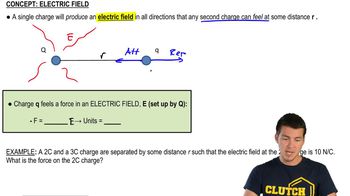
Electric Field

The electric field is a vector field that represents the force exerted by an electric charge on other charges in its vicinity. It is defined as the force per unit charge and is measured in newtons per coulomb (N/C). In this problem, the electric field at a specific point is influenced by the charges present, and understanding how to calculate the resultant electric field from multiple charges is crucial.
추천 영상:
가이드 코스
03:16
Intro to Electric Fields

Coulomb's Law

Coulomb's Law describes the electrostatic interaction between charged particles. It states that the force between two point charges is directly proportional to the product of their magnitudes and inversely proportional to the square of the distance between them. This law is essential for determining the force exerted by the known charge on the unknown charge and helps in calculating the unknown charge's value.
추천 영상:

Superposition Principle

The superposition principle in electrostatics states that the total electric field created by multiple charges is the vector sum of the electric fields produced by each charge independently. This principle allows us to analyze complex charge configurations by breaking them down into simpler components, making it easier to find the resultant electric field at a given point, as required in this problem.
추천 영상:
가이드 코스
03:32
Superposition of Sinusoidal Wave Functions
관련 실천
교과서 질문

Derive Equation 23.11 for the field Ē dipole in the plane that bisects an electric dipole.

195
views

교과서 질문

Electrostatic cleaners remove small dust particles and pollen grains from air by first ionizing them, then flowing the air between the plates of a parallel-plate capacitor, parallel to the plates, where electric forces deposit charged particles on one of the electrodes. A typical pollen grain has a mass of 5.0×10105.0\(\times\)10^{-10} g, the ionizer charges it with 750750 extra electrons, and a fan moves the air at 3.03.0 m/s. Ignore air resistance and gravity. What minimum electric field strength is needed to deflect the grain by 3.03.0 mm before it leaves the electrodes?

1923
views
교과서 질문

What are the strength and direction of the electric field at the position indicated by the dot in FIGURE P23.37? Give your answer (a) in component form and (b) as a magnitude and angle measured cw or ccw (specify which) from the positive x-axis.

210
views
교과서 질문

FIGURE P23.44 shows a thin rod of length L with total charge Q. Evaluate E at r=3.0 cm if L=5.0 cm and Q=3.0 nC.

73
views
교과서 질문

FIGURE P23.41 is a cross section of two infinite lines of charge that extend out of the page. Both have linear charge density λ. Find an expression for the electric field strength E at height y above the midpoint between the lines.

2267
views
교과서 질문

The permanent electric dipole moment of the water molecule (H2O) is 6.2×10306.2\(\times\)10^{-30} Cm. What is the maximum possible torque on a water molecule in a 5.0×1085.0×10^8 N/C electric field?

2672
views