Ch 23: The Electric Field
Knight Calc - Physics for Scientists and Engineers 5th Edition
Knight Calc5th EditionPhysics for Scientists and EngineersISBN: 9780137344796당신이 사용하는 게 아니라요?교과서 변경
23장, 문제 34

The permanent electric dipole moment of the water molecule (H2O) is 6.2×10306.2\(\times\)10^{-30} Cm. What is the maximum possible torque on a water molecule in a 5.0×1085.0×10^8 N/C electric field?

검증된 단계별 안내
1
Understand the problem: The torque (τ) on a dipole in an electric field is given by the formula τ = pE sin(θ), where p is the dipole moment, E is the electric field strength, and θ is the angle between the dipole moment and the electric field. The maximum torque occurs when sin(θ) = 1, i.e., when θ = 90°.
Identify the given values: The dipole moment of the water molecule is p = 6.2×10^−30 C·m, and the electric field strength is E = 5.0×10^8 N/C.
Substitute the given values into the formula for torque: τ = pE. Since sin(θ) = 1 for maximum torque, the formula simplifies to τ = (6.2×10^−30 C·m) × (5.0×10^8 N/C).
Perform the multiplication of the dipole moment and the electric field strength to calculate the maximum torque. Ensure the units are consistent (C·m × N/C = N·m, which is the unit of torque).
Interpret the result: The calculated torque represents the maximum rotational force experienced by the water molecule in the given electric field when the dipole is perpendicular to the field.

비슷한 문제에 대한 검증된 영상 답변:

이 영상 해법은 위 문제에 도움이 된다고 튜터들이 추천한 것입니다.
영상 길이:
2m

주요 개념

질문에 올바르게 답하기 위해 반드시 이해해야 하는 핵심 개념들은 다음과 같습니다.

Electric Dipole Moment

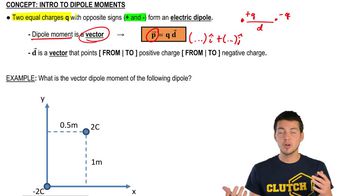
The electric dipole moment is a measure of the separation of positive and negative charges in a system. It is defined as the product of the charge and the distance between the charges. For a molecule like water, which has a permanent dipole due to its molecular structure, the dipole moment indicates how strongly the molecule can interact with an external electric field.
추천 영상:
가이드 코스
03:08
Intro To Dipole Moment

Torque on a Dipole in an Electric Field

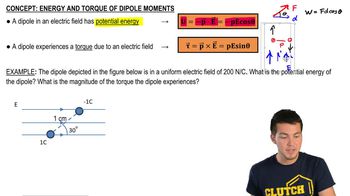
When an electric dipole is placed in an external electric field, it experiences a torque that tends to align it with the field. The torque ( au) can be calculated using the formula τ = pE sin(θ), where p is the dipole moment, E is the electric field strength, and θ is the angle between the dipole moment and the electric field direction. The maximum torque occurs when θ is 90 degrees, simplifying the equation to τ_max = pE.
추천 영상:
가이드 코스
05:19
Energy & Torque of Dipole Moments

Electric Field Strength

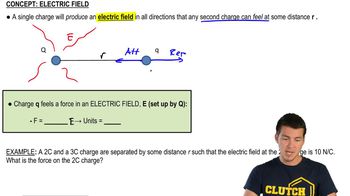
Electric field strength (E) is a measure of the force per unit charge experienced by a positive test charge placed in the field. It is expressed in newtons per coulomb (N/C). In this context, the electric field strength influences the torque experienced by the water molecule's dipole moment, determining how effectively the molecule can be oriented by the field.
추천 영상:
가이드 코스
03:16
Intro to Electric Fields
관련 실천
교과서 질문

A proton is fired horizontally into a 1.0×10⁵ N/C vertical electric field. It rises 1.0 cm vertically after having traveled 5.0 cm horizontally. What was the proton's initial speed?

2173
views
1
rank

교과서 질문

Electrostatic cleaners remove small dust particles and pollen grains from air by first ionizing them, then flowing the air between the plates of a parallel-plate capacitor, parallel to the plates, where electric forces deposit charged particles on one of the electrodes. A typical pollen grain has a mass of 5.0×10105.0\(\times\)10^{-10} g, the ionizer charges it with 750750 extra electrons, and a fan moves the air at 3.03.0 m/s. Ignore air resistance and gravity. What minimum electric field strength is needed to deflect the grain by 3.03.0 mm before it leaves the electrodes?

1923
views
교과서 질문

What are the strength and direction of the electric field at the position indicated by the dot in FIGURE P23.37? Give your answer (a) in component form and (b) as a magnitude and angle measured cw or ccw (specify which) from the positive x-axis.

210
views
교과서 질문

A −15 nC charge is at x=+2.0 cm on the x-axis. A second charge q is located somewhere on the x-axis to the left of the origin. The electric field at y=2.0 cm on the y-axis is E=3.0×10⁵i^\(\overrightarrow{E}\)=3.0\(\times\)10^5\(\hat{i}\)N/C . What are (a) the charge q in nC and (b) its distance from the origin?

2589
views
교과서 질문

INT The surface charge density on an infinite charged plane is −2.0×10⁻⁶ C/m2. A proton is shot straight away from the plane at 2.0×10⁶ m/s. How far does the proton travel before reaching its turning point?

2301
views
교과서 질문

FIGURE P23.41 is a cross section of two infinite lines of charge that extend out of the page. Both have linear charge density λ. Find an expression for the electric field strength E at height y above the midpoint between the lines.

2267
views