Ch 24: Gauss' Law
Knight Calc - Physics for Scientists and Engineers 5th Edition
Knight Calc5th EditionPhysics for Scientists and EngineersISBN: 9780137344796당신이 사용하는 게 아니라요?교과서 변경
24장, 문제 34b

A spherically symmetric charge distribution produces the electric field E=(5000r2)r^\(\overrightarrow{E}\)=\(\left\)(5000r^2\(\right\))\(\hat{r}\) N/C, where r is in m. How much charge is inside this 40-cm-diameter spherical surface?

검증된 단계별 안내
1
Step 1: Recognize that the problem involves a spherically symmetric charge distribution, and the electric field is given as a function of radial distance r. To find the charge enclosed within a spherical surface, we use Gauss's law: ∮E·dA = Q_enclosed/ε₀, where Q_enclosed is the charge inside the surface and ε₀ is the permittivity of free space.
Step 2: Write the expression for the electric field: E = (5000r²) N/C. Here, r is the radial distance in meters. The spherical surface has a diameter of 40 cm, so the radius r = 40 cm / 2 = 0.2 m.
Step 3: The surface area of a sphere is A = 4πr². Substitute r = 0.2 m into this formula to calculate the surface area of the spherical surface.
Step 4: Use Gauss's law to relate the electric field to the charge enclosed. The left-hand side of Gauss's law becomes ∮E·dA = E × A because the electric field is radially symmetric and constant over the surface. Substitute the expression for E and the calculated surface area A into this equation.
Step 5: Solve for Q_enclosed using the equation Q_enclosed = ε₀ × (E × A). Substitute the value of ε₀ (8.85 × 10⁻¹² C²/N·m²), the electric field E at r = 0.2 m, and the surface area A to find the charge enclosed within the spherical surface.

비슷한 문제에 대한 검증된 영상 답변:

이 영상 해법은 위 문제에 도움이 된다고 튜터들이 추천한 것입니다.
영상 길이:
7m
도움이 되었나요?

주요 개념

질문에 올바르게 답하기 위해 반드시 이해해야 하는 핵심 개념들은 다음과 같습니다.

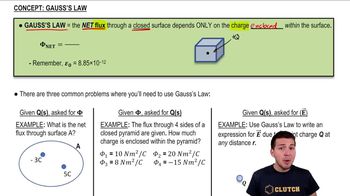
Gauss's Law

Gauss's Law relates the electric flux through a closed surface to the charge enclosed by that surface. Mathematically, it states that the total electric flux is equal to the enclosed charge divided by the permittivity of free space. This principle is crucial for analyzing electric fields produced by symmetric charge distributions, allowing us to simplify calculations by considering only the charge within a defined boundary.
추천 영상:
10:20
Gauss' Law

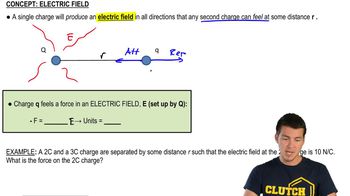
Electric Field

The electric field is a vector field that represents the force experienced by a unit positive charge placed in the field. It is defined as the force per unit charge and can vary with position. In this question, the electric field is given as a function of the radial distance, indicating how the field strength changes with distance from the center of the charge distribution.
추천 영상:
03:16
Intro to Electric Fields

Spherical Symmetry

Spherical symmetry refers to a situation where a physical quantity, such as charge distribution or electric field, is uniform in all directions from a central point. This symmetry simplifies the analysis of electric fields and potentials, as it allows the use of spherical coordinates and makes it easier to apply Gauss's Law. In this case, the charge distribution's spherical symmetry is key to determining the total charge within the specified spherical surface.
추천 영상:
가이드 코스
05:51
Refraction at Spherical Surfaces