Ch 24: Gauss' Law
Knight Calc - Physics for Scientists and Engineers 5th Edition
Knight Calc5th EditionPhysics for Scientists and EngineersISBN: 9780137344796당신이 사용하는 게 아니라요?교과서 변경
24장, 문제 39

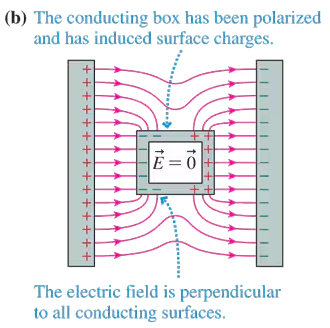
Figure 24.32b showed a conducting box inside a parallel-plate capacitor. The electric field inside the box is E=0\(\overrightarrow{E}\)=\(\overrightarrow{0}\). Suppose the surface charge on the exterior of the box could be frozen. Draw a picture of the electric field inside the box after the box, with its frozen charge, is removed from the capacitor. Hint: Superposition.
Illustration of a polarized conducting box with induced surface charges and zero electric field inside, surrounded by field lines.

검증된 단계별 안내
1
Understand the problem: The conducting box inside the parallel-plate capacitor initially has an electric field inside it of \( \mathbf{E} = 0 \). This is because the conducting box redistributes its charges to cancel the external electric field inside it. The problem asks us to analyze the electric field inside the box after it is removed from the capacitor, with its surface charge distribution frozen.
Recall the concept of superposition: The principle of superposition states that the net electric field at any point is the vector sum of the electric fields due to all charges present. In this case, the frozen surface charge on the box will now act as the source of the electric field.
Visualize the frozen charge distribution: When the box was inside the capacitor, the charges on its surface redistributed to cancel the external electric field inside the box. This means the surface charge distribution is non-uniform, with positive charges on one side and negative charges on the opposite side, corresponding to the direction of the original external field.
Determine the electric field inside the box: After the box is removed from the capacitor, the frozen surface charges will create their own electric field. Inside the box, the electric field will no longer be zero because the external field from the capacitor is no longer present to cancel the field due to the surface charges. The resulting electric field inside the box will depend on the frozen charge distribution and can be calculated using Gauss's law or Coulomb's law.
Draw the electric field: To represent the electric field inside the box, draw field lines originating from the positive charges on the surface and terminating at the negative charges. The field lines inside the box will point from the positively charged region to the negatively charged region, reflecting the frozen charge distribution.

비슷한 문제에 대한 검증된 영상 답변:

이 영상 해법은 위 문제에 도움이 된다고 튜터들이 추천한 것입니다.
영상 길이:
2m
도움이 되었나요?

주요 개념

질문에 올바르게 답하기 위해 반드시 이해해야 하는 핵심 개념들은 다음과 같습니다.

Electric Field

An electric field is a vector field that represents the force exerted by an electric charge on other charges in its vicinity. It is defined as the force per unit charge and is directed away from positive charges and toward negative charges. In the context of capacitors, the electric field between the plates is uniform and plays a crucial role in determining the behavior of charges within conductive materials.
추천 영상:
가이드 코스
03:16
Intro to Electric Fields

Superposition Principle

The superposition principle states that the total electric field created by multiple charges is the vector sum of the electric fields produced by each charge independently. This principle allows us to analyze complex charge distributions by considering the contributions from individual charges separately, making it essential for understanding the behavior of electric fields in various configurations, such as when a conducting box is involved.
추천 영상:
가이드 코스
03:32
Superposition of Sinusoidal Wave Functions

Conductors in Electrostatics

In electrostatics, conductors are materials that allow free movement of electric charges. When placed in an electric field, charges within a conductor redistribute themselves until the electric field inside the conductor is zero. This property is crucial for understanding how the conducting box affects the electric field in the capacitor and how the removal of the box will alter the field configuration in the surrounding space.
추천 영상:
가이드 코스
07:43
Electric Fields in Conductors
관련 실천
교과서 질문

A spherically symmetric charge distribution produces the electric field E=(5000r2)r^\(\overrightarrow{E}\)=\(\left\)(5000r^2\(\right\))\(\hat{r}\) N/C, where r is in m. How much charge is inside this 40-cm-diameter spherical surface?

1630
views

교과서 질문

An infinitely wide, horizontal metal plate lies above a horizontal infinite sheet of charge with surface charge density 800 nC/m2. The bottom surface of the plate has surface charge density -100 nC/m2. What is the surface charge density on the top surface of the plate?

1693
views
교과서 질문

The three parallel planes of charge shown in FIGURE P24.44 have surface charge densities ─ ½ η , η , and ─ ½ η. Find the electric fields EA\(\overrightarrow{E_{A}\)} to ED\(\overrightarrow{E_{D}\)} in regions A to D. The upward direction is the + y-direction.

2230
views
교과서 질문

An infinite slab of charge of thickness 2𝒵₀ lies in the xy-plane between 𝒵 = -𝒵₀ and 𝒵 = +𝒵₀ . The volume charge density p (C/m3) is a constant. Find an expression for the electric field strength above the slab (𝒵 ≥ 𝒵₀).

2512
views
교과서 질문

The earth has a vertical electric field at the surface, pointing down, that averages 100 N/C. This field is maintained by various atmospheric processes, including lightning. What is the excess charge on the surface of the earth?

2190
views
교과서 질문

A 20-cm-radius ball is uniformly charged to 80 nC. How much charge is enclosed by spheres of radii 5, 10, and 20 cm?

1831
views