Ch 24: Gauss' Law
Knight Calc - Physics for Scientists and Engineers 5th Edition
Knight Calc5th EditionPhysics for Scientists and EngineersISBN: 9780137344796당신이 사용하는 게 아니라요?교과서 변경
24장, 문제 38

The earth has a vertical electric field at the surface, pointing down, that averages 100 N/C. This field is maintained by various atmospheric processes, including lightning. What is the excess charge on the surface of the earth?

검증된 단계별 안내
1
Step 1: Understand the relationship between electric field and surface charge density. The electric field near a surface is related to the surface charge density (σ) by the equation: E = σε0, where E is the electric field, σ is the surface charge density, and ε0 is the permittivity of free space (approximately 8.85 × 10⁻¹² C2/N·m2). Rearrange this equation to solve for σ: σ = Eε0.
Step 2: Substitute the given value of the electric field into the equation. The electric field is given as 100 N/C. Use the permittivity of free space ε0 = 8.85 × 10⁻¹² C2/N·m2. Calculate the surface charge density σ using the formula: σ = Eε0.
Step 3: Relate the surface charge density to the total excess charge on the Earth's surface. The surface charge density σ is defined as the charge per unit area: σ = QA, where Q is the total charge and A is the surface area. Rearrange this equation to solve for Q: Q = σA.
Step 4: Use the approximate surface area of the Earth to calculate the total excess charge. The Earth's surface area is approximately 5.1 × 10¹⁴ m2. Substitute the calculated value of σ from Step 2 and the Earth's surface area into the formula Q = σA.
Step 5: Perform the multiplication to find the total excess charge Q. Ensure the units are consistent throughout the calculation (Coulombs for charge, square meters for area, etc.). The result will give the total excess charge on the Earth's surface.

비슷한 문제에 대한 검증된 영상 답변:

이 영상 해법은 위 문제에 도움이 된다고 튜터들이 추천한 것입니다.
영상 길이:
3m
도움이 되었나요?

주요 개념

질문에 올바르게 답하기 위해 반드시 이해해야 하는 핵심 개념들은 다음과 같습니다.

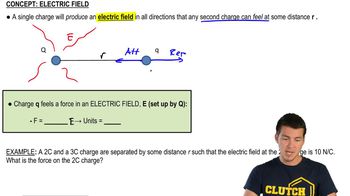
Electric Field

An electric field is a region around a charged object where other charged objects experience a force. It is defined as the force per unit charge and is measured in newtons per coulomb (N/C). In this context, the Earth's electric field of 100 N/C indicates the strength and direction of the force that a positive test charge would experience at the surface.
추천 영상:
가이드 코스
03:16
Intro to Electric Fields

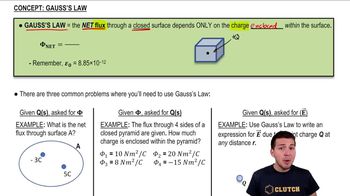
Gauss's Law

Gauss's Law relates the electric field at a surface to the charge enclosed by that surface. It states that the electric flux through a closed surface is proportional to the total charge enclosed within that surface. This principle is essential for calculating the excess charge on the Earth's surface by integrating the electric field over a hypothetical surface surrounding the Earth.
추천 영상:

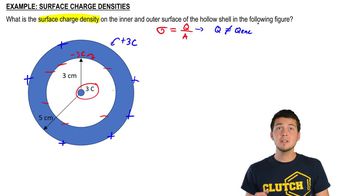
Surface Charge Density

Surface charge density is the amount of electric charge per unit area on a surface, typically expressed in coulombs per square meter (C/m²). It is crucial for determining the total excess charge on the Earth's surface when combined with the area over which the electric field acts. The relationship between electric field strength and surface charge density is given by the equation E = σ/ε₀, where ε₀ is the permittivity of free space.
추천 영상:
가이드 코스
04:03
Surface Charge Density
관련 실천
교과서 질문

A spherically symmetric charge distribution produces the electric field E=(5000r2)r^\(\overrightarrow{E}\)=\(\left\)(5000r^2\(\right\))\(\hat{r}\) N/C, where r is in m. How much charge is inside this 40-cm-diameter spherical surface?

1630
views

교과서 질문

An infinitely wide, horizontal metal plate lies above a horizontal infinite sheet of charge with surface charge density 800 nC/m2. The bottom surface of the plate has surface charge density -100 nC/m2. What is the surface charge density on the top surface of the plate?

1693
views
교과서 질문

Charges q1=4Qq_1 = -4Q and q2=+2Qq_2 = +2Q are located at 𝓍=a𝓍 = -a and 𝓍=+a𝓍 = +a, respectively. What is the net electric flux through a sphere of radius 2a2a centered (a) at the origin and (b) at 𝓍=2a𝓍 = 2a?

2086
views
교과서 질문

The three parallel planes of charge shown in FIGURE P24.44 have surface charge densities ─ ½ η , η , and ─ ½ η. Find the electric fields EA\(\overrightarrow{E_{A}\)} to ED\(\overrightarrow{E_{D}\)} in regions A to D. The upward direction is the + y-direction.

2230
views
교과서 질문

Figure 24.32b showed a conducting box inside a parallel-plate capacitor. The electric field inside the box is E=0\(\overrightarrow{E}\)=\(\overrightarrow{0}\). Suppose the surface charge on the exterior of the box could be frozen. Draw a picture of the electric field inside the box after the box, with its frozen charge, is removed from the capacitor. Hint: Superposition.

1332
views
교과서 질문

A 20-cm-radius ball is uniformly charged to 80 nC. How much charge is enclosed by spheres of radii 5, 10, and 20 cm?

1831
views