Ch 27: Current and Resistance
Knight Calc - Physics for Scientists and Engineers 5th Edition
Knight Calc5th EditionPhysics for Scientists and EngineersISBN: 9780137344796당신이 사용하는 게 아니라요?교과서 변경
27장, 문제 26b

A 1.5 V battery provides 0.50 A of current. How much work does the charge escalator do to lift 1.0 C of charge?

검증된 단계별 안내
1
Understand the relationship between voltage, work, and charge. The work done by the battery on a charge is given by the formula: W = q V, where W is the work, q is the charge, and V is the voltage.
Identify the given values in the problem: the voltage of the battery is 1.5 V, and the charge to be lifted is 1.0 C.
Substitute the given values into the formula: W = 1.0 1.5.
Simplify the expression to calculate the work done. This will give the amount of energy (in joules) required to lift the charge.
Conclude that the work done by the charge escalator is directly proportional to the product of the charge and the voltage, as shown in the formula.

비슷한 문제에 대한 검증된 영상 답변:

이 영상 해법은 위 문제에 도움이 된다고 튜터들이 추천한 것입니다.
영상 길이:
2m
도움이 되었나요?

주요 개념

질문에 올바르게 답하기 위해 반드시 이해해야 하는 핵심 개념들은 다음과 같습니다.

Voltage

Voltage, measured in volts (V), is the electric potential difference between two points in a circuit. It represents the energy per unit charge available to move charges through a circuit. In this question, the 1.5 V battery indicates that each coulomb of charge has 1.5 joules of energy available to do work.
추천 영상:
07:14
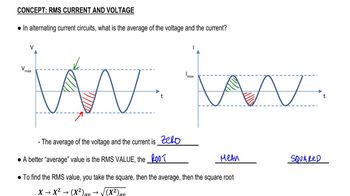
RMS Current and Voltage

Current

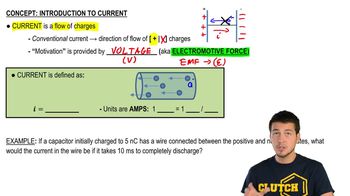
Current, measured in amperes (A), is the flow of electric charge in a circuit. It quantifies how much charge passes through a point in the circuit per unit time. In this scenario, a current of 0.50 A means that 0.50 coulombs of charge flow through the circuit every second, which is essential for calculating the work done on the charge.
추천 영상:
05:38
Intro to Current

Work Done by Electric Charge

The work done by an electric charge when moving through a potential difference is calculated using the formula W = Q × V, where W is work in joules, Q is charge in coulombs, and V is voltage in volts. In this case, lifting 1.0 C of charge through a 1.5 V potential difference results in 1.5 joules of work done, illustrating the relationship between charge, voltage, and work.
추천 영상:
05:37
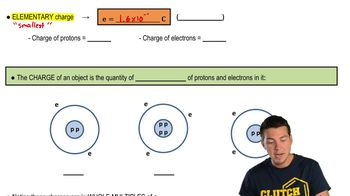
Electric Charge