Ch 27: Current and Resistance
Knight Calc - Physics for Scientists and Engineers 5th Edition
Knight Calc5th EditionPhysics for Scientists and EngineersISBN: 9780137344796당신이 사용하는 게 아니라요?교과서 변경
27장, 문제 30a

How long must a 0.60-mm-diameter aluminum wire be to have a 0.50 A current when connected to the terminals of a 1.5 V flashlight battery?

검증된 단계별 안내
1
Determine the resistivity of aluminum (ρ). This is a material property and can be found in a reference table. For aluminum, ρ ≈ 2.65 × 10⁻⁸ Ω·m.
Calculate the cross-sectional area (A) of the wire using the formula for the area of a circle: A = π(d/2)², where d is the diameter of the wire. Convert the diameter from millimeters to meters before substituting.
Use Ohm's Law, V = IR, to find the resistance (R) of the wire. Rearrange the formula to R = V/I, where V is the voltage (1.5 V) and I is the current (0.50 A).
Relate the resistance (R) to the resistivity (ρ), length (L), and cross-sectional area (A) using the formula R = ρ(L/A). Rearrange this formula to solve for the length: L = R(A/ρ).
Substitute the values of R, A, and ρ into the formula for L to calculate the required length of the wire. Ensure all units are consistent (e.g., meters, ohms, etc.) before performing the calculation.

비슷한 문제에 대한 검증된 영상 답변:

이 영상 해법은 위 문제에 도움이 된다고 튜터들이 추천한 것입니다.
도움이 되었나요?

주요 개념

질문에 올바르게 답하기 위해 반드시 이해해야 하는 핵심 개념들은 다음과 같습니다.

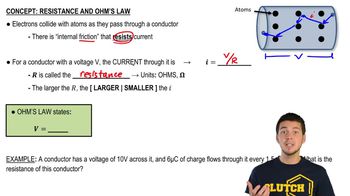
Ohm's Law

Ohm's Law states that the current (I) flowing through a conductor between two points is directly proportional to the voltage (V) across the two points and inversely proportional to the resistance (R) of the conductor. This relationship is expressed by the formula V = I * R, which is essential for calculating the resistance needed for a specific current and voltage.
추천 영상:
03:07
Resistance and Ohm's Law

Resistance of a Wire

The resistance (R) of a wire is determined by its material, length (L), and cross-sectional area (A). The formula R = ρ * (L/A) is used, where ρ is the resistivity of the material. For aluminum, knowing its resistivity allows us to calculate how long the wire must be to achieve the desired resistance for the given current and voltage.
추천 영상:
09:57
Magnetic Force on Current-Carrying Wire

Cross-Sectional Area

The cross-sectional area (A) of a wire is crucial in determining its resistance. For a cylindrical wire, the area can be calculated using the formula A = π * (d/2)², where d is the diameter. In this problem, the diameter of the aluminum wire is given, allowing us to compute the area and subsequently the resistance needed to maintain the specified current.
추천 영상:
08:10
Calculating the Vector (Cross) Product Using Components