Ch 27: Current and Resistance
Knight Calc - Physics for Scientists and Engineers 5th Edition
Knight Calc5th EditionPhysics for Scientists and EngineersISBN: 9780137344796당신이 사용하는 게 아니라요?교과서 변경
27장, 문제 29

The electric field inside a 30-cm-long copper wire is 5.0 mV/m. What is the potential difference between the ends of the wire?

검증된 단계별 안내
1
Identify the relationship between electric field (E), potential difference (V), and distance (d). The formula is: V = E × d, where V is the potential difference, E is the electric field, and d is the distance.
Convert the given distance from centimeters to meters, as the electric field is given in units of volts per meter (mV/m). Use the conversion: 1 \, \(\text{cm}\) = 0.01 \, \(\text{m}\). Therefore, 30 \, \(\text{cm}\) = 0.30 \, \(\text{m}\).
Substitute the given values into the formula. The electric field is 5.0 \, \(\text{mV/m}\) (convert to volts: 5.0 \, \(\text{mV/m}\) = 0.005 \, \(\text{V/m}\)), and the distance is 0.30 \, \(\text{m}\).
Perform the multiplication: V = 0.005 \, \(\text{V/m}\) × 0.30 \, \(\text{m}\). This will give the potential difference in volts.
Express the final result in volts (V) after performing the multiplication. Ensure the units are consistent and correctly labeled.

비슷한 문제에 대한 검증된 영상 답변:

이 영상 해법은 위 문제에 도움이 된다고 튜터들이 추천한 것입니다.
도움이 되었나요?

주요 개념

질문에 올바르게 답하기 위해 반드시 이해해야 하는 핵심 개념들은 다음과 같습니다.

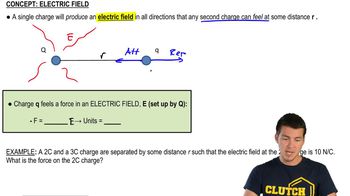
Electric Field

The electric field is a vector field that represents the force per unit charge experienced by a positive test charge placed in the field. It is measured in volts per meter (V/m) or millivolts per meter (mV/m). In this context, the electric field indicates how the electric potential changes along the length of the copper wire.
추천 영상:
가이드 코스
03:16
Intro to Electric Fields

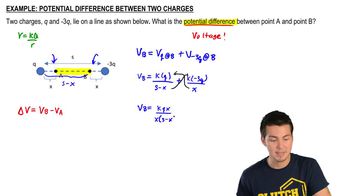
Potential Difference

Potential difference, also known as voltage, is the work done per unit charge in moving a charge between two points in an electric field. It is measured in volts (V). The potential difference across the ends of the wire can be calculated by multiplying the electric field by the length of the wire, providing insight into how much energy is available to move charges through the wire.
추천 영상:
가이드 코스
07:04
Potential Difference Between Two Charges

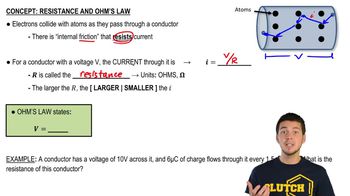
Ohm's Law

Ohm's Law states that the current flowing through a conductor between two points is directly proportional to the voltage across the two points and inversely proportional to the resistance of the conductor. While not directly needed to find the potential difference in this question, understanding Ohm's Law helps contextualize the relationship between electric field, potential difference, and current in conductive materials.
추천 영상:
가이드 코스
03:07
Resistance and Ohm's Law