Ch 27: Current and Resistance
Knight Calc - Physics for Scientists and Engineers 5th Edition
Knight Calc5th EditionPhysics for Scientists and EngineersISBN: 9780137344796당신이 사용하는 게 아니라요?교과서 변경
27장, 문제 8a

The mean time between collisions for electrons in a gold wire is 25 fs, where 1 fs = 1 femtosecond = 10⁻¹⁵ s. What is the electron drift speed in a 35 mV/m electric field?

검증된 단계별 안내
1
Understand the problem: The drift speed of electrons in a conductor is related to the electric field, the mean time between collisions (relaxation time), and the properties of the electron. The formula to use is: vd=eEτ/me, where vd is the drift speed, e is the charge of an electron, E is the electric field, τ is the mean time between collisions, and me is the mass of an electron.
Identify the given values: The electric field E is 35 mV/m = 35 × 10-3 V/m, the mean time between collisions τ is 25 fs = 25 × 10-15 s, the charge of an electron e is 1.6 × 10⁻¹⁹ C, and the mass of an electron me is 9.11 × 10⁻³¹ kg.
Substitute the known values into the formula: vd=(1.6×10⁻¹⁹)(35×10-3)(25×10-15)/(9.11×10-31).
Simplify the numerator: Multiply the values for e, E, and τ to calculate the numerator of the formula.
Divide the result of the numerator by the mass of the electron me to find the drift speed vd. Ensure the units are consistent throughout the calculation to obtain the final drift speed in meters per second (m/s).

비슷한 문제에 대한 검증된 영상 답변:

이 영상 해법은 위 문제에 도움이 된다고 튜터들이 추천한 것입니다.
도움이 되었나요?

주요 개념

질문에 올바르게 답하기 위해 반드시 이해해야 하는 핵심 개념들은 다음과 같습니다.

Drift Speed

Drift speed refers to the average velocity that charged particles, such as electrons, attain due to an electric field. It is a crucial concept in understanding how electric current flows through conductors. The drift speed can be calculated using the formula v_d = I/(nqA), where I is the current, n is the charge carrier density, q is the charge of the electron, and A is the cross-sectional area of the conductor.
추천 영상:
가이드 코스
07:59
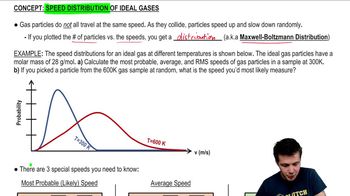
Speed Distribution & Special Speeds of Ideal Gases

Mean Time Between Collisions

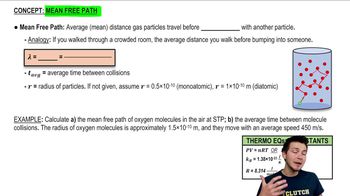
The mean time between collisions is the average time interval that an electron travels before colliding with an atom in a conductor. This concept is significant in determining the mobility of electrons and affects their drift speed. A shorter mean time indicates more frequent collisions, which can slow down the drift speed of electrons in a material.
추천 영상:

Electric Field

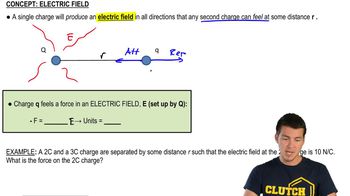
An electric field is a region around a charged particle where other charged particles experience a force. It is quantified in volts per meter (V/m) and influences the motion of charged particles within it. In this context, the electric field of 35 mV/m provides the driving force that causes electrons to drift, contributing to the overall current in the wire.
추천 영상:
가이드 코스
03:16
Intro to Electric Fields