Draw a circuit diagram for the circuit of FIGURE EX28.2.
Ch 28: Fundamentals of Circuits
28장, 문제 11
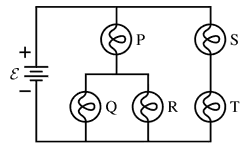
The five identical bulbs in FIGURE EX28.11 are all glowing. The battery is ideal. What is the order of brightness of the bulbs, from brightest to dimmest? Some may be equal.

검증된 단계별 안내1
Analyze the circuit diagram in FIGURE EX28.11 to identify how the bulbs are connected (series, parallel, or a combination). This will help determine the current and voltage distribution across each bulb.
Recall that the brightness of a bulb is proportional to the power it dissipates, which can be expressed as \( P = I^2 R \) or \( P = \frac{V^2}{R} \), where \( I \) is the current through the bulb, \( V \) is the voltage across it, and \( R \) is the resistance of the bulb.
Determine the equivalent resistance of the circuit by simplifying the series and parallel combinations of the bulbs. This will allow you to calculate the total current supplied by the battery.
Using the total current and the rules for current and voltage distribution in series and parallel circuits, calculate the current through and voltage across each bulb. This will help you compare their power outputs.
Rank the bulbs in order of brightness based on their power outputs, noting that bulbs with the same current and voltage will have equal brightness.

비슷한 문제에 대한 검증된 영상 답변:
이 영상 해법은 위 문제에 도움이 된다고 튜터들이 추천한 것입니다.
영상 길이:
8m도움이 되었나요?
주요 개념
질문에 올바르게 답하기 위해 반드시 이해해야 하는 핵심 개념들은 다음과 같습니다.
Series and Parallel Circuits
In electrical circuits, components can be arranged in series or parallel configurations. In a series circuit, the same current flows through all components, leading to equal brightness if the components are identical. In a parallel circuit, each component receives the full voltage of the battery, which can result in brighter bulbs since they operate independently.
추천 영상:
가이드 코스
Combining Capacitors in Series & Parallel
Ohm's Law
Ohm's Law states that the current (I) through a conductor between two points is directly proportional to the voltage (V) across the two points and inversely proportional to the resistance (R) of the conductor. This relationship helps determine how voltage and resistance affect the brightness of bulbs, as brightness is related to the power (P = IV) consumed by each bulb.
추천 영상:
가이드 코스
Resistance and Ohm's Law
Power Dissipation in Resistors
The power dissipated by a resistor (or bulb) in an electrical circuit is given by the formula P = I^2R, where I is the current through the resistor and R is its resistance. For identical bulbs, the brightness is proportional to the power they dissipate; thus, understanding how current divides in series and parallel circuits is crucial for determining which bulbs will be brighter or dimmer.
추천 영상:
가이드 코스
Power in Circuits
관련 실천
교과서 질문
1582
views
교과서 질문
Draw a graph of the potential as a function of the distance traveled through the circuit, traveling cw from V = 0 V at the lower left corner.
111
views
교과서 질문
A typical American family uses 1000 kWh of electricity a month. What is the average current in the 120 V power line to the house?
147
views
교과서 질문
A 60 W lightbulb and a 100 W lightbulb are placed in the circuit shown in FIGURE EX28.9. Both bulbs are glowing. Which bulb is brighter? Or are they equally bright?
1347
views
교과서 질문
A typical American family uses 1000 kWh of electricity a month. On average, what is the resistance of a household?
107
views
교과서 질문
A 100 W (120 V) incandescent lightbulb contains a 7.0-cm-long tungsten filament. The high-temperature resistivity of tungsten is 9.0 x 10⁻⁷ Ωm. What is the diameter of the filament?
77
views