Ch 28: Fundamentals of Circuits
Knight Calc - Physics for Scientists and Engineers 5th Edition
Knight Calc5th EditionPhysics for Scientists and EngineersISBN: 9780137344796당신이 사용하는 게 아니라요?교과서 변경
28장, 문제 9a

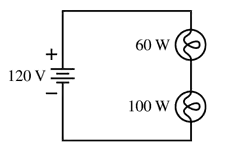
A 60 W lightbulb and a 100 W lightbulb are placed in the circuit shown in FIGURE EX28.9. Both bulbs are glowing. Which bulb is brighter? Or are they equally bright?
Circuit diagram showing a 60 W and a 100 W lightbulb connected to a 120 V power source, both bulbs glowing.

검증된 단계별 안내
1
Step 1: Understand the relationship between power, voltage, and resistance. The power of a bulb is given by the formula: Pbulb = V2/R, where V is the voltage across the bulb and R is the resistance of the bulb.
Step 2: Recall that the resistance of a bulb can be calculated using the formula: R = V2/P. Since the power ratings of the bulbs are given (60 W and 100 W), their resistances can be compared. The bulb with lower power rating will have higher resistance.
Step 3: Analyze the circuit configuration. If the bulbs are connected in series, the current through both bulbs will be the same. In this case, the bulb with higher resistance (60 W bulb) will have a larger voltage drop across it, making it brighter. If the bulbs are connected in parallel, the voltage across both bulbs will be the same, and the bulb with higher power rating (100 W bulb) will be brighter.
Step 4: Determine the circuit type based on the problem context or diagram (FIGURE EX28.9). If the bulbs are in series, brightness depends on resistance; if in parallel, brightness depends on power rating.
Step 5: Conclude which bulb is brighter based on the circuit type. For series circuits, the 60 W bulb is brighter due to higher resistance. For parallel circuits, the 100 W bulb is brighter due to higher power rating.

비슷한 문제에 대한 검증된 영상 답변:

이 영상 해법은 위 문제에 도움이 된다고 튜터들이 추천한 것입니다.
영상 길이:
2m
도움이 되었나요?

주요 개념

질문에 올바르게 답하기 위해 반드시 이해해야 하는 핵심 개념들은 다음과 같습니다.

Power Rating

The power rating of a lightbulb, measured in watts (W), indicates the rate at which it converts electrical energy into light and heat. A higher wattage means the bulb consumes more energy and typically produces more light. In this case, the 100 W bulb is designed to emit more light than the 60 W bulb when both are operating under the same voltage.
추천 영상:

Brightness Perception

Brightness perception is influenced by the amount of light emitted by a bulb and how our eyes perceive that light. The human eye responds logarithmically to light intensity, meaning that a bulb with a higher power rating will generally appear brighter. Therefore, the 100 W bulb will appear brighter than the 60 W bulb due to its higher light output.
추천 영상:
가이드 코스
12:00
Young's Double Slit Experiment

Circuit Configuration

The configuration of the circuit affects how voltage and current are distributed among the components. If the bulbs are connected in series, they share the same current, which can affect their brightness. In a parallel configuration, each bulb receives the full voltage, allowing the 100 W bulb to shine brighter than the 60 W bulb, confirming that the power rating directly influences brightness.
추천 영상: