Ch 28: Fundamentals of Circuits
Knight Calc - Physics for Scientists and Engineers 5th Edition
Knight Calc5th EditionPhysics for Scientists and EngineersISBN: 9780137344796당신이 사용하는 게 아니라요?교과서 변경
28장, 문제 2

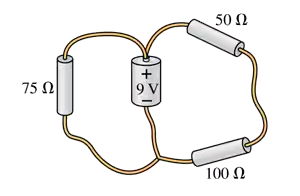
Draw a circuit diagram for the circuit of FIGURE EX28.2.
Circuit diagram showing a 9V battery connected to three resistors: 75Ω, 50Ω, and 100Ω in a combination circuit.

검증된 단계별 안내
1
Identify the components of the circuit described in FIGURE EX28.2, such as resistors, capacitors, inductors, voltage sources, or current sources. Note their arrangement and connections.
Determine the type of circuit (e.g., series, parallel, or a combination) based on the description or visual representation provided in FIGURE EX28.2.
Use standard circuit symbols to represent each component. For example, use a zigzag line for resistors, a pair of parallel lines for capacitors, and a coil for inductors.
Arrange the components in the diagram according to their connections in the circuit. Ensure that all nodes and branches are accurately represented, and label each component with its value or identifier if provided.
Double-check the diagram for accuracy, ensuring that it matches the configuration described in FIGURE EX28.2 and adheres to standard circuit diagram conventions.

비슷한 문제에 대한 검증된 영상 답변:

이 영상 해법은 위 문제에 도움이 된다고 튜터들이 추천한 것입니다.
영상 길이:
2m
도움이 되었나요?

주요 개념

질문에 올바르게 답하기 위해 반드시 이해해야 하는 핵심 개념들은 다음과 같습니다.

Circuit Diagram

A circuit diagram is a graphical representation of an electrical circuit, showing the components and their connections. It uses standardized symbols to represent elements like resistors, capacitors, and power sources, allowing for easy understanding and analysis of the circuit's function. Accurate circuit diagrams are essential for troubleshooting and constructing electrical systems.
추천 영상:
가이드 코스
08:07
Work and PV Diagrams

Components of a Circuit

Electrical circuits consist of various components, including power sources (like batteries), conductors (wires), and loads (like resistors or bulbs). Each component has a specific role; for example, power sources provide energy, while loads consume it. Understanding these components and their functions is crucial for drawing and analyzing circuit diagrams.
추천 영상:
가이드 코스
07:30
Vector Addition By Components

Ohm's Law

Ohm's Law is a fundamental principle in electronics that relates voltage (V), current (I), and resistance (R) in a circuit, expressed as V = IR. This law helps in calculating the behavior of electrical circuits, allowing one to determine how much current will flow through a circuit given a certain voltage and resistance. Mastery of Ohm's Law is essential for analyzing and designing circuits.
추천 영상:
가이드 코스
03:07
Resistance and Ohm's Law