Ch 41: Atomic Physics
Knight Calc - Physics for Scientists and Engineers 5th Edition
Knight Calc5th EditionPhysics for Scientists and EngineersISBN: 9780137344796당신이 사용하는 게 아니라요?교과서 변경
41장, 문제 40

A sodium atom emits a photon with wavelength 818 nm shortly after being struck by an electron. What minimum speed did the electron have before the collision?

검증된 단계별 안내
1
Step 1: Begin by understanding the relationship between the energy of the emitted photon and its wavelength. Use the formula for photon energy: E=hcλ, where h is Planck's constant (6.63×1034 J·s), c is the speed of light (3.00×10 m/s), and λ is the wavelength of the photon (818 nm, converted to meters as 818×109 m).
Step 2: Calculate the energy of the photon using the formula from Step 1. This energy represents the minimum energy transferred to the sodium atom during the collision.
Step 3: Recognize that the electron must have had at least this amount of kinetic energy before the collision to transfer it to the sodium atom. Use the kinetic energy formula for the electron: K=12mv2, where m is the mass of the electron (9.11×1031 kg) and v is its speed.
Step 4: Rearrange the kinetic energy formula to solve for the speed of the electron: v=2Km. Substitute the energy of the photon (calculated in Step 2) for K and the mass of the electron for m.
Step 5: Perform the substitution and simplify the expression to find the minimum speed of the electron. This speed corresponds to the energy required to emit the photon with a wavelength of 818 nm.

비슷한 문제에 대한 검증된 영상 답변:

이 영상 해법은 위 문제에 도움이 된다고 튜터들이 추천한 것입니다.
영상 길이:
5m
도움이 되었나요?

주요 개념

질문에 올바르게 답하기 위해 반드시 이해해야 하는 핵심 개념들은 다음과 같습니다.

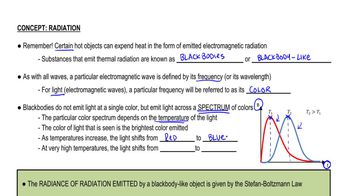
Photon Emission

Photon emission occurs when an atom transitions from a higher energy state to a lower energy state, releasing energy in the form of light. The wavelength of the emitted photon is inversely related to the energy difference between these states, as described by the equation E = hc/λ, where E is energy, h is Planck's constant, c is the speed of light, and λ is the wavelength.
추천 영상:

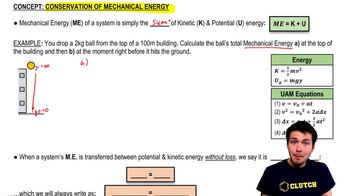
Energy Conservation

In physics, the principle of energy conservation states that energy cannot be created or destroyed, only transformed from one form to another. In this scenario, the kinetic energy of the incoming electron is converted into the energy of the emitted photon, allowing us to relate the electron's speed to the energy of the photon produced.
추천 영상:
가이드 코스
06:24
Conservation Of Mechanical Energy

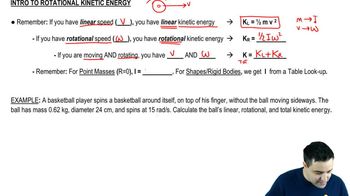
Kinetic Energy

Kinetic energy is the energy possessed by an object due to its motion, calculated using the formula KE = 1/2 mv², where m is mass and v is velocity. To find the minimum speed of the electron, we can equate its kinetic energy to the energy of the emitted photon, allowing us to solve for the electron's initial speed before the collision.
추천 영상:
가이드 코스
06:07
Intro to Rotational Kinetic Energy