Intro to Fractals: 동영상 및 연습문제
Intro to Fractals focuses on fractal geometry, which studies figures built by starting with a shape and applying the same rule again and again. This repeated process is called recursion: take a starting figure, apply a rule, then apply that rule to the result indefinitely. Fractals are useful for describing repetitive patterns that do not fit ordinary Euclidean geometry, including shapes that appear in nature.
A central property of many fractals is self-similarity, meaning smaller pieces of the figure resemble the whole fractal. The Sierpinski triangle shows this clearly: begin with an equilateral triangle, remove the center triangle formed by connecting the midpoints, and repeat that same rule on each remaining smaller triangle. Another common fractal is the fractal tree, formed by repeated branching. Fractals are understood as the result of continuing the rule infinitely many times, even though in practice they become visually stable after many steps, when further changes are too small to notice.
Intro to Fractals


Determine if the following figure has self-similarity.
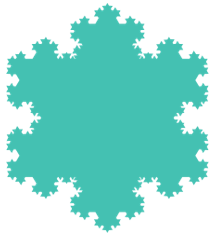
Yes; the figure has self-similarity.
No; the figure lacks self-similarity.
Cannot be determined
Determine if the following figure has self-similarity.
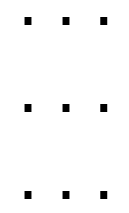
Yes; the figure has self-similarity.
No; the figure lacks self-similarity.
Cannot be determined
Intro to Fractals Example 1
Intro to Fractals Example 2
Intro to Fractals Example 3
학생들이 이 주제에 대해 묻는 질문은 다음과 같습니다:
A fractal is a complex geometric figure created by repeating a simple process called recursion infinitely many times. Unlike traditional Euclidean geometry, which studies basic shapes like squares, triangles, and cubes, fractal geometry describes shapes that exhibit intricate, self-similar patterns at every scale. For example, the Sierpinski triangle starts with an equilateral triangle, then repeatedly removes the center triangle formed by connecting midpoints, creating smaller triangles that resemble the whole. This self-similarity and infinite repetition distinguish fractals from Euclidean shapes, which are typically smooth and regular. Fractals are especially useful for modeling natural phenomena like Romanesco broccoli or branching trees, which cannot be accurately described by classical geometry.
Self-similarity in fractals means that smaller parts of the fractal resemble the entire figure. This property is a defining characteristic of fractals. For instance, in the Sierpinski triangle, each smaller triangle formed after removing the center triangle looks like a miniature version of the whole fractal. This pattern repeats infinitely as the fractal is generated through recursion. Self-similarity allows fractals to model natural objects that have repeating patterns at different scales, such as coastlines, snowflakes, and plants. It also means that zooming into any part of the fractal reveals a structure similar to the original, no matter how deep you go.
The Sierpinski triangle is constructed by starting with an equilateral triangle and applying a recursive rule repeatedly. The rule is to remove the center triangle formed by connecting the midpoints of the sides of the current triangle. After the first step, this removal creates three smaller equilateral triangles at the corners. The same rule is then applied to each of these smaller triangles, removing their centers, and this process continues infinitely. Mathematically, this recursion can be described as applying the function to the triangle, where removes the center triangle. Repeating infinitely many times results in the fractal Sierpinski triangle, which exhibits self-similarity and a visually stable pattern after many iterations.
Fractals become visually stable after many iterations because the changes between successive steps become so small that they are no longer noticeable to the human eye. Although fractals are defined by applying a rule infinitely many times, in practice, after a certain number of recursive steps, the fractal's pattern appears to stop changing significantly. This is due to the scale of the features becoming too small to distinguish without powerful magnification. For example, in the Sierpinski triangle, after many iterations, the removed center triangles are so tiny that the overall shape looks stable and complete. This visual stability allows us to study fractals practically, even though their mathematical definition involves infinite repetition.
Natural examples of fractals include Romanesco broccoli, snowflakes, coastlines, and branching trees. These objects exhibit complex, repeating patterns at different scales that cannot be described accurately by traditional Euclidean geometry. Fractals are useful for describing these natural forms because they capture the self-similar and recursive nature of their structures. For instance, Romanesco broccoli consists of spiral-shaped buds covered in smaller spiral-shaped buds, a pattern that repeats at multiple scales. Fractal geometry provides a mathematical framework to model and analyze such patterns, helping scientists and mathematicians understand the complexity and scaling behavior of natural phenomena.