Similar Figures: 동영상 및 연습문제
Similar Figures have the same shape even if their sizes are different. Two figures are similar when their corresponding angles have equal measure and their corresponding sides are proportional. This means one figure is a scaled version of the other, and matching vertices must be identified carefully. Similarity is written with the symbol \(\triangle ABC \sim \triangle XYZ\) .
To work with similar figures, first match corresponding vertices using angle markings, side positions, or the order in a similarity statement. Then write equal ratios using matching sides, such as \(\frac{AB}{XY}=\frac{BC}{YZ}=\frac{AC}{XZ}\) . Keep all numerators from one figure and all denominators from the other. These proportions can be used to find missing side lengths, and equal corresponding angles can be used to determine unknown angle measures.
Similar Triangles


Similar Triangles Example 1
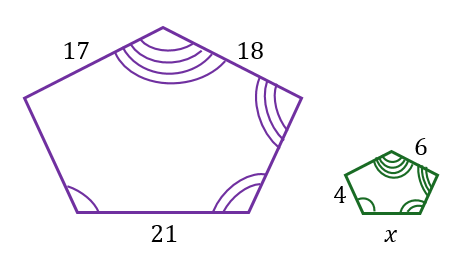
The following shapes are similar. Find .
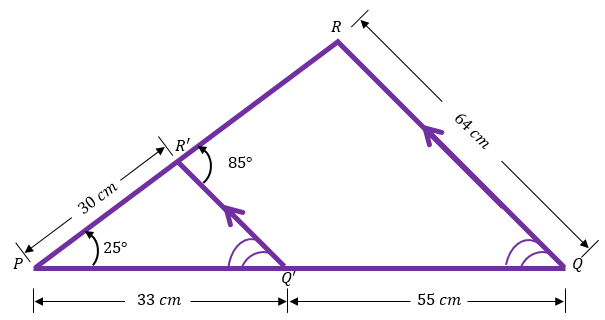
Use the similar triangles to find the following:
(A)
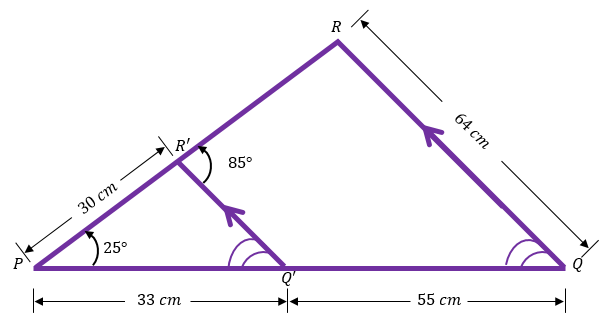
Use the similar triangles to find the following:
(B) The length of
cm
cm
cm
cm
Similar Triangles Example 2
학생들이 이 주제에 대해 묻는 질문은 다음과 같습니다:
Two figures are considered similar in geometry if they satisfy two main criteria. First, their corresponding angles must have equal measures. This means that each angle in one figure matches exactly in measure with the corresponding angle in the other figure. Second, their corresponding sides must be proportional. This means the lengths of corresponding sides have the same ratio, indicating one figure is a scaled version of the other. For example, if one triangle has sides twice as long as the corresponding sides of another triangle, and their angles match, the triangles are similar. This relationship is often written symbolically as , where the order of vertices corresponds to matching angles and sides.
To identify corresponding sides and angles in similar triangles, start by matching the vertices in the order given in the similarity statement. The first vertex in one triangle corresponds to the first vertex in the other, the second to the second, and so on. Corresponding angles are those at these matched vertices. For example, if , then angle A corresponds to angle X, B to Y, and C to Z. Corresponding sides are the sides opposite these angles. So side AB corresponds to side XY, BC to YZ, and AC to XZ. Using angle markings or labels helps confirm these matches. Correctly identifying corresponding parts is essential for setting up proportions to solve for unknown side lengths or angle measures.
When two figures are similar, their corresponding sides are proportional, meaning the ratios of their lengths are equal. To find a missing side length, set up a proportion using pairs of corresponding sides. For example, if , and you know the lengths of sides AB, BC, XY, and one unknown side length corresponding to BC, you can write the proportion as . Cross-multiply and solve for the unknown . This method relies on keeping all numerators from one triangle and all denominators from the other to maintain consistent ratios. This approach is widely used in geometry problems involving similar figures.
The order of vertices in similarity statements is crucial because it indicates which angles and sides correspond between the two figures. For example, in the statement , vertex A corresponds to X, B to Y, and C to Z. This order ensures that when setting up proportions or comparing angles, you match the correct parts. If the order is incorrect, such as , the correspondence is lost, and the similarity statement is invalid. Maintaining the correct order helps avoid errors in calculations and ensures accurate identification of corresponding sides and angles.
The similarity symbol between two triangles is written as . This symbol means "is similar to." It indicates that the two triangles have the same shape but possibly different sizes. The order of the vertices in the statement shows which angles and sides correspond. For example, angle A corresponds to angle X, side AB corresponds to side XY, and so forth. This notation is essential for communicating similarity clearly and is used to set up proportions or prove geometric properties involving similar figures.