Perimeter and Area of Polygons: 동영상 및 연습문제
Perimeter is the distance around the outside of a polygon, found by adding all side lengths. For a rectangle, a useful shortcut is \(P=2L+2W\) . For irregular or compound polygons, first find any missing side lengths using the given dimensions, then trace the figure carefully so each side is counted once. Perimeter keeps the original linear units.
Area is the amount of space inside a polygon, and it is always written in square units. Key formulas include the area of a rectangle, \(A=L\times W\) , the area of a triangle, \(A=\frac{1}{2}bh\) , a square \(A=s^2\), a parallelogram \(A=bh\), and the area of a trapezoid, \(A=\frac{1}{2}(B_1+B_2)h\) . In Perimeter and Area of Polygons, compound figures are handled by splitting them into known shapes and adding their areas.
Perimeter


Find the perimeter of the isosceles triangle (two sides have equal length).
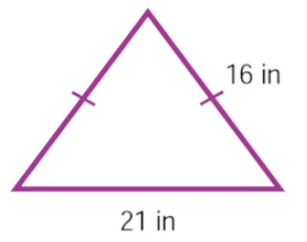
in
in
in
in
Find the perimeter of a rectangle with length 12 yd and width 8 yd.
yd
yd
yd
yd
Perimeter Example 1
Perimeter Example 2
Area
Find the area of the figure.
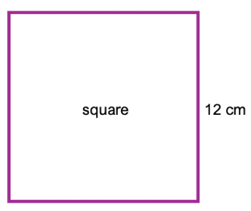
cm2
cm2
cm2
cm2
Find the area of the figure.
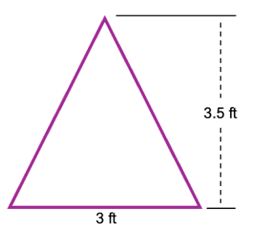
ft2
ft2
ft2
ft2
Find the area of the figure.
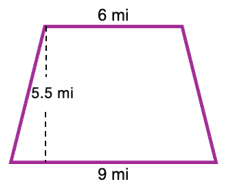
mi2
mi2
mi2
mi2
Area Example 3
Area Example 4
학생들이 이 주제에 대해 묻는 질문은 다음과 같습니다:
To find the perimeter of an irregular polygon with missing side lengths, first identify the known side lengths and use the properties of the shape to find the unknown sides. For example, if the polygon is a compound shape made of rectangles, you can add or subtract parallel side lengths to find missing lengths. Once all side lengths are known, carefully trace the polygon and add each side length exactly once to get the total perimeter. Remember, the perimeter is the sum of all side lengths around the polygon, and the units remain the same as those given for the sides.
The formula for the perimeter of a rectangle is , where is the length and is the width. This formula is useful because rectangles have opposite sides equal, so instead of adding all four sides individually, you can multiply the length and width by 2 and then add them. This shortcut simplifies calculations and reduces errors when finding the perimeter of rectangles.
The area of a trapezoid is calculated using the formula , where and are the lengths of the two parallel bases, and is the height (the perpendicular distance between the bases). You add the lengths of the two bases, multiply by the height, and then multiply by one-half. The height must be perpendicular to the bases for the formula to be valid.
Area is expressed in square units because it measures the amount of space inside a polygon. If the side lengths are given in linear units like inches or meters, the area units will be those units squared, such as square inches () or square meters (). This is because area is a two-dimensional measurement, involving length multiplied by width or height, so the units are multiplied as well.
To find the area of a compound polygon, split the shape into simpler known shapes such as rectangles, triangles, or trapezoids. Calculate the area of each smaller shape using the appropriate formulas, then add all these areas together to get the total area of the compound polygon. This method works because area is additive, and breaking down complex shapes makes calculations manageable.