Intro to Geometry: 동영상 및 연습문제
Intro to Geometry begins with the basic building blocks of geometric figures: point, line, ray, segment, angle, and plane. A point is a location in space with no length or width. A line extends forever in both directions, has no width, and has zero endpoints. A ray starts at one endpoint and continues forever in one direction, while a segment has two endpoints and a finite length that can be measured.
Naming matters in geometry. A line can be named by any two points on it, and a segment is named by its endpoints. A ray must be named with its endpoint first. An angle is formed by two rays that share an endpoint called the vertex. When naming an angle with three points, the vertex must be the middle letter. A plane extends forever in length and width. A key relationship for segment lengths is $PR = PQ + QR$
Intro to Geometry


Determine whether PQ, as shown in each object, is a line, ray, or segment.
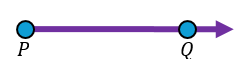
Line
Ray
Segment
Determine whether PQ, as shown in each object, is a line, ray, or segment.
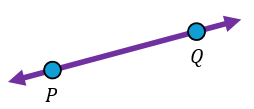
Line
Ray
Segment
Determine whether PQ, as shown in each object, is a line, ray, or segment.
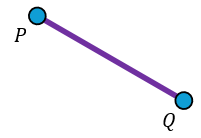
Line
Ray
Segment
Calculate the length of line segment given the diagram below & inches & .

in
in
in
in
Intro to Geometry Example 1
학생들이 이 주제에 대해 묻는 질문은 다음과 같습니다:
The basic building blocks of geometry include points, lines, rays, segments, angles, and planes. A point is a precise location in space with no length or width, represented by a dot and labeled with a capital letter. A line extends infinitely in both directions, has no width, and contains no endpoints; it is named using any two points on it or a lowercase cursive letter. A ray starts at one endpoint and extends infinitely in one direction, named starting with its endpoint followed by another point on the ray. A line segment has two endpoints and a finite length that can be measured, named by its endpoints. An angle is formed by two rays sharing a common endpoint called the vertex, and it is named using three points with the vertex in the middle. Finally, a plane extends infinitely in length and width, often named with a capital letter.
To name a ray correctly, you must start with its endpoint followed by another point on the ray. This order is important because a ray has one fixed starting point and extends infinitely in only one direction. For example, if the endpoint is point A and another point on the ray is point B, the ray is named . Naming it would be incorrect because it would imply the ray starts at point B, which it does not. The arrow above the letters points away from the endpoint, indicating the direction of the ray. This naming convention helps clearly distinguish rays from lines and segments, which have different properties regarding endpoints and direction.
A line extends infinitely in both directions and has no endpoints, meaning it has infinite length and no width. It is represented with arrowheads on both ends. A ray starts at one endpoint and extends infinitely in one direction, having one endpoint and infinite length. It is represented with an arrowhead on only one end, pointing away from the endpoint. A line segment has two endpoints and a finite length that can be measured, with no arrowheads on either end. It is essentially a portion of a line bounded by two points. All three have no width, but their key differences lie in their length and number of endpoints.
An angle is formed when two rays share a common endpoint called the vertex. The rays are the sides of the angle, and the vertex is the point where they meet. To name an angle correctly, use three points: one point on the first ray, the vertex point in the middle, and one point on the second ray. For example, if the rays are and sharing vertex B, the angle can be named or . The vertex must always be the middle letter. Sometimes, if there is no ambiguity, the angle can be named simply by its vertex, such as .
A plane in geometry is a flat, two-dimensional surface that extends infinitely in all directions along its length and width. Unlike lines, which extend infinitely in one dimension, planes extend infinitely in two dimensions, similar to an endless whiteboard stretching up, down, left, and right. Planes have infinite length and infinite width but no thickness. They are typically named using a single capital letter, such as plane . Planes serve as the foundational surfaces on which points, lines, rays, and other geometric figures can lie.