Skip to main content
Macroeconomics
My Course
Learn
Exam Prep
AI Tutor
Study Guides
Flashcards
Explore
Try the app
My Course
Learn
Exam Prep
AI Tutor
Study Guides
Flashcards
Explore
Try the app
Back
Classical Model and Keynesian Model definitions
You can tap to flip the card.
Classical Model
You can tap to flip the card.
👆
Classical Model
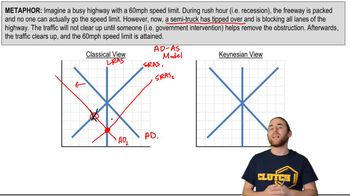
An economic framework assuming flexible prices and wages, full employment, and self-correction without government action.
Track progress
Control buttons has been changed to "navigation" mode.
1/15
Related flashcards
Related practice
Recommended videos
Classical Model and Keynesian Model quiz
Classical Model and Keynesian Model
15 Terms
Classical Model and Keynesian Model
22. Macroeconomic Schools of Thought
10 problems
Topic
Monetarist Model
22. Macroeconomic Schools of Thought
10 problems
Topic
24. Macroeconomic Schools of Thought
7 topics
15 problems
Chapter
Guided course
02:54
Classical Model
1710
views
29
rank
Guided course
03:41
Graphical Comparison of Classical Model and Keynesian Model
1612
views
28
rank
Guided course
03:04
Keynesian Model
1633
views
21
rank
Terms in this set (15)
Hide definitions
Classical Model
An economic framework assuming flexible prices and wages, full employment, and self-correction without government action.
Keynesian Model
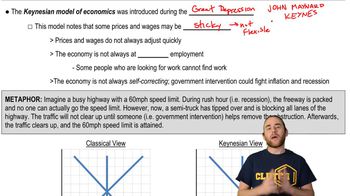
An economic framework emphasizing sticky prices and wages, possible unemployment, and the need for government intervention.
Flexible Prices
A condition where costs of goods and services adjust rapidly to changes in market conditions, restoring equilibrium quickly.
Sticky Wages
A situation where compensation does not adjust quickly to economic shifts, often due to contracts or institutional factors.
Full Employment
A state where all available labor resources are being used efficiently, with anyone seeking work able to find a job.
Self-Correction
A process where market forces alone restore economic stability after disruptions, without outside intervention.
Laissez Faire
An approach advocating minimal government involvement in economic affairs, allowing markets to operate freely.
Government Intervention
Actions by public authorities to influence economic outcomes, especially during recessions or inflation.
Aggregate Demand
The total demand for goods and services within an economy at a given overall price level and time period.
Aggregate Supply
The total output of goods and services that firms in an economy are willing to produce at a given price level.
Short Run Equilibrium
A temporary state where aggregate demand and aggregate supply intersect, possibly away from full employment.
Long Run Equilibrium
A condition where the economy's output matches its potential, with no pressure for prices or output to change.
Potential GDP
The highest level of output an economy can sustain over time without increasing inflation.
Invisible Hand
A metaphor for the self-regulating nature of markets, where individual actions collectively benefit the economy.
Recession
A period of declining economic activity, often marked by reduced output and rising unemployment.
 BackBack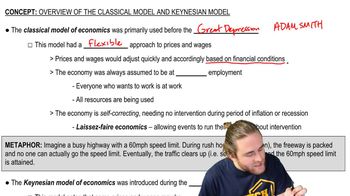
 02:54
02:54