Who developed the Classical model of economics and in which famous work were its ideas first presented?
Adam Smith developed the Classical model, and its ideas were first presented in 'The Wealth of Nations.'
What is the main assumption about prices and wages in the Classical model?
The Classical model assumes that prices and wages are flexible and adjust quickly to changes in the economy.
How does the Classical model view the need for government intervention in the economy?
The Classical model believes the economy is self-correcting and does not require government intervention.
What economic condition does the Classical model assume is always present?
The Classical model assumes that the economy is always at full employment, meaning anyone who wants a job can get one.
What metaphor is used to describe the self-correcting nature of the Classical model?
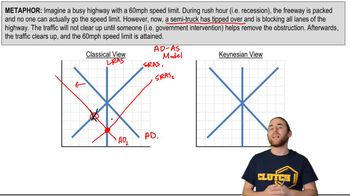
The Classical model is compared to a busy highway that eventually clears up on its own after rush hour, representing the economy returning to normal without intervention.
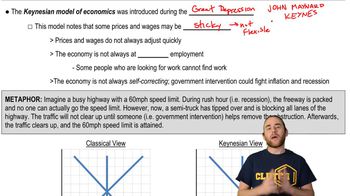
Who introduced the Keynesian model and during what historical event?
John Maynard Keynes introduced the Keynesian model during the Great Depression.
What does the Keynesian model say about the flexibility of prices and wages?
The Keynesian model argues that prices and wages can be 'sticky,' meaning they do not adjust quickly to changes in the economy.
According to the Keynesian model, is the economy always at full employment?
No, the Keynesian model recognizes that the economy may not always be at full employment and some people may be unable to find work.
Why might wages be 'sticky' according to the Keynesian model?
Wages might be sticky due to factors like labor contracts, which fix wages for a set period regardless of economic conditions.
How does the Keynesian model view the role of government intervention?
The Keynesian model believes government intervention is sometimes necessary to help the economy recover from recessions or fight inflation.
What metaphor is used to illustrate the need for intervention in the Keynesian model?
The Keynesian model is likened to a highway blocked by a semi-truck, which requires government intervention to remove the obstruction and restore normal flow.
In the Classical model, how does the economy respond to a fall in aggregate demand?
The Classical model predicts that the economy will immediately adjust back to long-run equilibrium without a period of short-run disequilibrium.
In the Keynesian model, what happens after a fall in aggregate demand?
The Keynesian model suggests the economy may remain in a short-run equilibrium with output below potential GDP before eventually returning to long-run equilibrium, possibly with government help.
What is the main graphical difference between the Classical and Keynesian models in the aggregate demand-aggregate supply framework?
In the Classical model, the economy instantly returns to long-run equilibrium, while in the Keynesian model, there is a period of short-run equilibrium before returning to long-run equilibrium.
What is meant by 'laissez faire' in the context of the Classical model?
'Laissez faire' refers to the policy of non-intervention, allowing the economy to self-correct without government involvement.
 Back
Back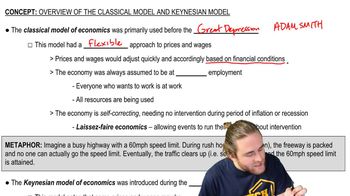
 02:54
02:54