Money supply M1 does not include the currency held by which group?
M1 does not include currency held by banks or the government; it only includes currency in circulation held by the public.
What are the two main components of the M1 money supply?
The two main components of M1 are currency in circulation and checking account deposits.
Why are credit cards not included in the M1 money supply?
Credit cards are not included because they represent borrowing, not actual money held or available for spending.
What is the main difference between M1 and M2 in terms of their definitions?
M1 is a narrow definition including only the most liquid forms of money, while M2 is a broader definition that includes M1 plus additional types of accounts like savings.
Which type of account is included in M2 but not in M1?
Savings accounts are included in M2 but not in M1.
How does the size of M2 generally compare to M1?
M2 is typically about 4 to 5 times larger than M1.
What small component is technically included in M1 but makes up a negligible portion?
Traveler's checks are included in M1 but make up a negligible portion.
What is a money market mutual fund deposit, and in which money supply measure is it included?
A money market mutual fund deposit is an interest-earning account with good liquidity, and it is included in M2.
Why is M1 emphasized more than M2 in this course?
M1 is emphasized because it is easier to use and focuses on the most liquid forms of money available for spending.
What is a certificate of deposit and in which money supply measure is it counted?
A certificate of deposit is a savings account with funds locked for a set period, and it is counted in M2.
 Back
Back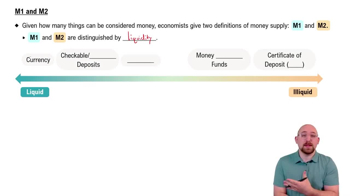
 02:14
02:14