Disinflation and Deflation quiz #1 Flashcards

Disinflation and Deflation quiz #1
Control buttons has been changed to "navigation" mode.
1/10
  • Which of the following describes the Volcker disinflation most accurately?
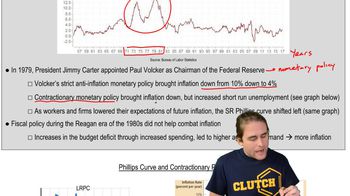
    The Volcker disinflation refers to the period in the late 1970s and early 1980s when Federal Reserve Chairman Paul Volcker used strict contractionary monetary policy to significantly reduce the U.S. inflation rate from around 10% to 4%. This policy lowered inflation but caused a sharp increase in short-run unemployment, as shown by movement along the Phillips Curve. In the long run, lower inflation expectations shifted the Short Run Phillips Curve to the left, stabilizing inflation at a lower rate and returning unemployment to its natural rate.
  • What is the key difference between disinflation and deflation?
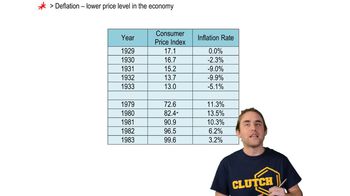
    Disinflation is a reduction in the inflation rate while it remains positive, whereas deflation is when the inflation rate is negative and the price level actually falls.
  • During disinflation, what happens to the price level?
    The price level continues to rise, but at a slower rate than before.
  • How does contractionary monetary policy affect unemployment in the short run?
    Contractionary monetary policy increases short-run unemployment as inflation is reduced.
  • What role do inflation expectations play in the long-run adjustment after disinflation?
    Lowered inflation expectations shift the Short Run Phillips Curve to the left, leading to a new equilibrium with lower inflation and natural unemployment.
  • What was the effect of fiscal policy during the Volcker disinflation period?
    Fiscal policy increased the budget deficit and aggregate demand, which worked against the contractionary monetary policy by adding inflationary pressure.
  • How can you easily identify a period of deflation using inflation rates?
    Deflation is easily identified by a negative inflation rate, indicating that prices are lower than the previous year.
  • What does a movement down the Short Run Phillips Curve represent during disinflation?
    It represents a decrease in inflation accompanied by an increase in unemployment.
  • What happens to the natural rate of unemployment in the long run after disinflation?
    In the long run, unemployment returns to its natural rate as inflation expectations adjust.
  • Why is it important not to confuse disinflation with deflation on exams?
    Because disinflation means slower inflation while deflation means falling prices, and distinguishing them is a common test question.