Skip to main content
Macroeconomics
My Course
Learn
Exam Prep
AI Tutor
Study Guides
Flashcards
Explore
Try the app
My Course
Learn
Exam Prep
AI Tutor
Study Guides
Flashcards
Explore
Try the app
Back
Fractions Review definitions
You can tap to flip the card.
Fraction
You can tap to flip the card.
👆
Fraction
A numerical expression representing a part of a whole, written with a numerator above a denominator.
Track progress
Control buttons has been changed to "navigation" mode.
1/15
Related flashcards
Related practice
Recommended videos
Fractions Review quiz
Fractions Review
15 Terms
Fractions Review
1. Introduction to Macroeconomics
9 problems
Topic
Percentage and Decimal Review
1. Introduction to Macroeconomics
10 problems
Topic
1. Introduction to Macroeconomics - Part 1 of 2
8 topics
14 problems
Chapter
1. Introduction to Macroeconomics - Part 2 of 2
1 topic
3 problems
Chapter
01:39
Simplifying Fractions
1
views
Guided course
02:40
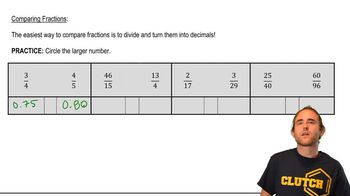
Comparing Fractions
2924
views
39
rank
05:25
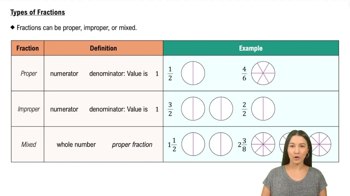
Types of Fractions
2
views
Terms in this set (15)
Hide definitions
Fraction
A numerical expression representing a part of a whole, written with a numerator above a denominator.
Numerator
The upper part of a fraction, indicating how many parts are considered out of the whole.
Denominator
The lower part of a fraction, showing the total number of equal parts in the whole.
Common Factor
A number that divides both the numerator and denominator without leaving a remainder.
Simplified Fraction
A fraction in which the numerator and denominator share no common factors other than 1.
Decimal Equivalent
A value obtained by dividing the numerator by the denominator, expressing the fraction as a decimal.
Even Number
A whole number divisible by 2, often used to quickly identify possible simplification steps.
Whole Number
A non-fractional, non-decimal number, sometimes resulting from fully simplifying a fraction.
Zero Removal
A shortcut for simplifying fractions when both numerator and denominator end in zero.
Division
The arithmetic operation used to find decimal equivalents or to simplify fractions by common factors.
Comparison
The process of determining which of two fractions represents a larger or smaller value.
Calculator
A tool frequently used to perform division for simplification or to find decimal equivalents.
Step-by-Step Reduction
A methodical approach to simplifying fractions by dividing by common factors repeatedly.
Less Than Sign
A mathematical symbol used to indicate that one value is smaller than another when comparing fractions.
Equal Fractions
Two fractions that represent the same value, often revealed by converting to decimals.
 BackBack
 01:39
01:39