Back

Public Solutions to Externalities definitions

Control buttons has been changed to "navigation" mode.
1/15
  • Externality

    A cost or benefit imposed on people not directly involved in a market transaction, such as pollution or vaccination effects.
  • Command and Control

    A policy approach where the government mandates or prohibits specific behaviors, like requiring education or banning chemical dumping.
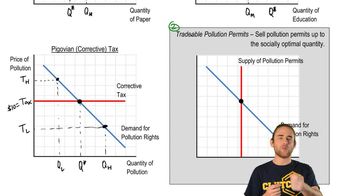
  • Corrective Tax

    A charge set equal to the external cost, designed to align private and social costs and achieve efficient market outcomes.
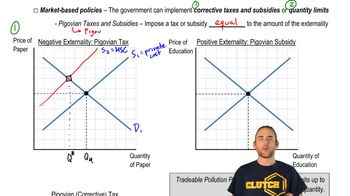
  • Pigovian Tax

    A levy named after economist Pigou, imposed to internalize external costs and guide markets to the socially optimal quantity.
  • Subsidy

    A financial incentive provided to increase production or consumption of goods with external benefits, such as education.
  • Quantity Limitation

    A restriction on the total amount of an externality, often implemented through permits that cap activities like pollution.
  • Pollution Permit

    A tradable allowance granting the right to emit a specific amount of pollution, creating a market for pollution rights.
  • Marginal Social Cost

    The total cost to society from producing one more unit, including both private and external costs.
  • Marginal Social Benefit

    The total benefit to society from consuming one more unit, including both private and external benefits.
  • Internalization

    The process of incorporating external costs or benefits into market decisions, ensuring all impacts are considered.
  • Market-Based Policy

    An approach using incentives like taxes or subsidies to influence behavior and address externalities efficiently.
  • Deadweight Loss

    A loss of economic efficiency that can occur when equilibrium is not achieved due to unaccounted externalities.
  • Equilibrium Quantity

    The amount of a good or externality where supply and demand, including all costs and benefits, are balanced.
  • Tax Revenue

    Funds collected by the government from imposed taxes, which can be used for public purposes such as environmental programs.
  • Tradable Permit

    A marketable authorization allowing holders to engage in a regulated activity, such as emitting a set amount of pollution.