What does it mean to 'internalize an externality' in economics?
To internalize an externality means to bring the external cost or benefit into the market transaction so that those involved account for the full social cost or benefit.
What is a command and control policy for externalities?
A command and control policy is when the government requires or forbids certain behaviors, such as mandating education or banning chemical dumping.
How do corrective (Pigovian) taxes address negative externalities?
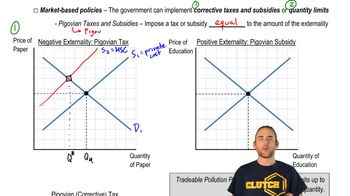
Corrective taxes are set equal to the external cost, aligning private costs with social costs and reducing the quantity of the negative externality to the efficient level.
Why are corrective taxes also called Pigovian taxes?
They are named after economist Arthur Pigou, who proposed using taxes and subsidies to correct externalities.
How do subsidies help address positive externalities?
Subsidies increase the quantity of goods with positive externalities by bridging the gap between private and social benefits, encouraging more production or consumption.
What is the effect of a corrective tax on the market equilibrium for a good with a negative externality?
A corrective tax shifts the equilibrium to a lower quantity, reflecting the true social cost and reducing overproduction.
Why might it not be efficient to eliminate all pollution according to economic theory?
Some pollution can provide benefits that outweigh the costs, so the efficient level is not zero but where marginal benefit equals marginal cost.
How does a subsidy affect the price paid by buyers and received by sellers in a market with a positive externality?
A subsidy lowers the price buyers pay and increases the price sellers receive, encouraging more transactions to reach the efficient quantity.
What is a quantity limitation in the context of externalities?
A quantity limitation sets a fixed cap on the amount of an externality, such as pollution, often implemented through tradable permits.
How do pollution permits work to control externalities?
The government issues a set number of permits allowing a certain amount of pollution, and firms can buy and sell these permits, creating a market price for pollution.
What happens if a corrective tax on pollution is set too high?
If the tax is too high, the quantity of pollution will be too low, meaning society misses out on some beneficial production.
What happens if a corrective tax on pollution is set too low?
If the tax is too low, there will be too much pollution, and the negative externality will not be fully addressed.
How is the price of pollution permits determined in the market?
The price is determined by where the fixed supply of permits set by the government meets the demand for pollution rights from firms.
What are the main public solutions to externalities discussed in the lesson?
The main solutions are command and control policies, corrective taxes and subsidies, and quantity limitations like tradable pollution permits.
Why might the government use a combination of tools to address externalities?
Different externalities and market conditions may require different approaches, so using a mix of command and control, taxes, subsidies, and permits can more effectively internalize externalities.
 Back
Back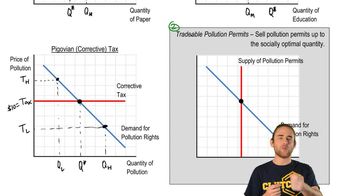
 04:07
04:07