Quantity Theory of Money quiz #1 Flashcards

Quantity Theory of Money quiz #1
Control buttons has been changed to "navigation" mode.
1/10
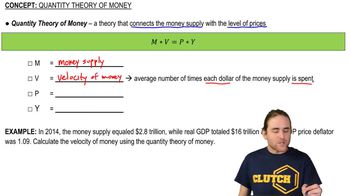
  • If Y (real GDP) and V (velocity of money) are constant and M (money supply) doubles, what does the quantity theory of money imply will happen to the price level (P)?
    According to the quantity theory of money (M × V = P × Y), if Y and V are constant and M doubles, the price level (P) will also double.
  • What does the velocity of money represent in the quantity theory of money equation?
    It represents the average number of times each dollar is spent in the economy in a year.
  • How is the price level (P) defined in the context of the quantity theory of money?
    The price level (P) refers to the average level of prices in the economy, often measured by a price index or deflator.
  • If the velocity of money is approximately 6, what does this indicate about the use of money in the economy?
    It means that, on average, each dollar is spent six times per year.
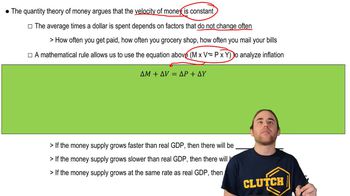
  • Why does the quantity theory of money often assume that the velocity of money is constant?
    Because the frequency of regular transactions like salary payments and bill payments does not change much over time.
  • What happens to the price level if the money supply grows slower than real GDP, according to the quantity theory of money?
    The price level will decrease, resulting in deflation.
  • How can the quantity theory of money equation be used to analyze inflation?
    By expressing the equation in terms of changes (growth rates) in the variables, it shows how changes in money supply and GDP affect inflation.
  • What is the mathematical relationship between changes in money supply, velocity, price level, and GDP in the modified quantity theory of money equation?
    The change in money supply plus the change in velocity equals the change in price level plus the change in real GDP.
  • What does it mean if the money supply and real GDP grow at the same rate according to the quantity theory of money?
    It means the price level will remain stable, resulting in no inflation or deflation.
  • In the example from 2014, what values were used to calculate the velocity of money, and what was the result?
    A money supply of $2.8 trillion, real GDP of $16 trillion, and a price deflator of 1.09 were used, resulting in a velocity of approximately 6.