Skip to main content
Macroeconomics
My Course
Learn
Exam Prep
AI Tutor
Study Guides
Flashcards
Explore
Try the app
My Course
Learn
Exam Prep
AI Tutor
Study Guides
Flashcards
Explore
Try the app
Back
Shifting Demand definitions
You can tap to flip the card.
Ceteris Paribus
You can tap to flip the card.
👆
Ceteris Paribus
A Latin phrase meaning all other factors are held constant when analyzing the effect of one variable, such as price, on demand.
Track progress
Control buttons has been changed to "navigation" mode.
1/15
Related flashcards
Related practice
Recommended videos
Shifting Demand quiz
Shifting Demand
15 Terms
Shifting Demand
3. Supply and Demand
10 problems
Topic
The Basics of Supply
3. Supply and Demand
10 problems
Topic
3. Supply and Demand - Part 1 of 2
11 topics
15 problems
Chapter
3. Supply and Demand - Part 2 of 2
1 topic
3 problems
Chapter
Guided course
01:27
Substitute and Complementary Goods
473
views
9
rank
Guided course
03:59
Shifting Demand
718
views
20
rank
Guided course
01:44
Consumer Preferences
588
views
16
rank
Terms in this set (15)
Hide definitions
Ceteris Paribus
A Latin phrase meaning all other factors are held constant when analyzing the effect of one variable, such as price, on demand.
Demand Curve
A graphical representation showing the relationship between a product's price and the quantity consumers are willing to buy.
Quantity Demanded
The specific amount of a good consumers are willing to purchase at a given price, represented by a point on the demand curve.
Determinant
A factor other than price, such as preferences or income, that can cause the entire demand curve to shift.
Normal Good
A product for which demand increases as consumer income rises, reflecting typical purchasing behavior.
Inferior Good
A product for which demand decreases as consumer income rises, often replaced by higher-quality alternatives.
Substitute
A product that can replace another in consumption; if its price rises, demand for the alternative increases.
Complement
A product consumed together with another; if its price rises, demand for the paired good decreases.
Consumer Preferences
Tastes or trends influencing how much of a product people desire, independent of price changes.
Consumer Expectations
Beliefs about future events, such as price changes, that affect current demand for a product.
Number of Consumers
The total population in a market; an increase leads to higher demand, while a decrease lowers demand.
Change in Demand
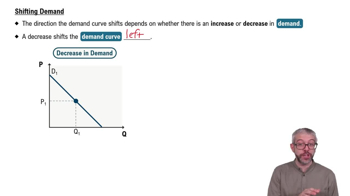
A shift of the entire demand curve due to a determinant other than price, indicating more or less is desired at every price.
Change in Quantity Demanded
A movement along the demand curve caused solely by a change in the product's price.
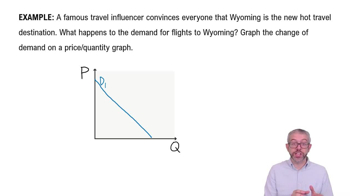
Rightward Shift
A movement of the demand curve to the right, indicating an increase in demand at all price levels.
Leftward Shift
A movement of the demand curve to the left, indicating a decrease in demand at all price levels.
 BackBack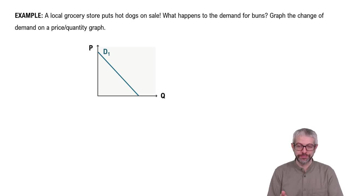
 01:27
01:27