Back

2) Avoiding Phagocytosis quiz

Control buttons has been changed to "navigation" mode.
1/15
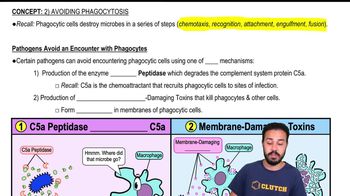
  • What is the function of C5a peptidase produced by some pathogens?

    C5a peptidase degrades the complement protein C5a, preventing the recruitment of phagocytic cells to the infection site.
  • How do membrane-damaging toxins help pathogens avoid phagocytosis?

    Membrane-damaging toxins create pores in phagocytic cell membranes, causing cell lysis and preventing engulfment of the pathogen.
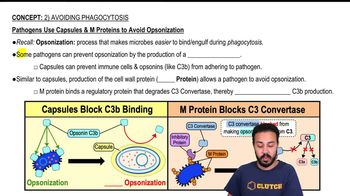
  • What is opsonization in the context of phagocytosis?

    Opsonization is the process that makes microbes easier to bind and engulf by phagocytic cells, often through the attachment of opsonins like C3b.
  • How do bacterial capsules prevent opsonization?

    Capsules block immune cells and opsonins such as C3b from adhering to the pathogen, thereby preventing opsonization and phagocytosis.
  • What are capsules composed of, and what is their role in immune evasion?

    Capsules are composed of carbohydrates and proteins, and they help pathogens evade the immune system by preventing opsonin binding.
  • How does the M protein on bacterial cell walls contribute to avoiding phagocytosis?

    M protein binds to regulatory proteins that degrade C3 convertase, blocking the production of C3b and thus preventing opsonization.
  • What is the role of C3 convertase in the complement system?

    C3 convertase is an enzyme that activates the complement system by converting C3 into C3a and C3b, with C3b acting as an opsonin.
  • How does the degradation of C3 convertase affect phagocytosis?

    Degradation of C3 convertase prevents the formation of C3b, reducing opsonization and making it harder for phagocytes to engulf pathogens.
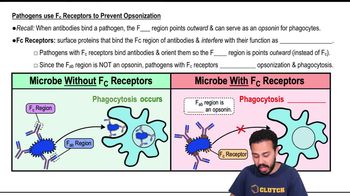
  • What are Fc receptors and how do they help pathogens avoid phagocytosis?

    Fc receptors are surface proteins on pathogens that bind the Fc region of antibodies, preventing the antibodies from functioning as opsonins.
  • How does the orientation of antibodies change when bound by Fc receptors on pathogens?

    When bound by Fc receptors, the antibody's Fc region is attached to the pathogen, leaving the FAB region pointing outward, which does not promote phagocytosis.
  • Why does binding of the FAB region outward by Fc receptors prevent phagocytosis?

    The FAB region is not an opsonin, so when it points outward, phagocytes cannot recognize and engulf the pathogen efficiently.
  • What is the normal orientation of antibodies on pathogens without Fc receptors?

    Normally, antibodies bind with their antigen-binding (FAB) regions to the pathogen and their Fc regions pointing outward, facilitating phagocytosis.
  • How can some pathogens induce apoptosis in phagocytic cells after being engulfed?

    Some pathogens survive inside phagocytic cells and trigger apoptosis, leading to the death of the phagocyte and escape of the pathogen.
  • What is the effect of preventing opsonization on the likelihood of phagocytosis?

    Preventing opsonization makes it more difficult for phagocytic cells to recognize and engulf pathogens, allowing the microbes to evade destruction.
  • What are two main mechanisms pathogens use to avoid encountering phagocytes?

    Pathogens can avoid phagocytes by producing C5a peptidase to degrade chemoattractants or by releasing membrane-damaging toxins that kill phagocytic cells.