Back

5) Avoiding Antibodies quiz

Control buttons has been changed to "navigation" mode.
1/15
  • What is one way bacteria can avoid being targeted by antibodies in mucus membranes?

    Bacteria can produce IgA proteases, which degrade IgA antibodies found in mucus membranes, allowing them to evade the adaptive immune response.
  • What is the main function of IgA antibodies in the immune system?

    IgA antibodies are primarily found in mucus membranes and help protect against pathogens by tagging them for destruction.
  • How do IgA proteases help bacteria evade the immune system?

    IgA proteases degrade IgA antibodies, making them nonfunctional and preventing them from tagging pathogens for destruction.
  • What is antigenic variation in bacteria?

    Antigenic variation is when bacteria constantly change their surface antigens to avoid being recognized and targeted by antibodies.
  • Why does antigenic variation make it difficult for the immune system to eliminate bacteria?

    Because antibodies produced against one antigen cannot bind to new, altered antigens, allowing bacteria to stay ahead of the immune response.
  • What happens when a bacterium changes its surface antigen from antigen A to antigen B?

    Antibodies specific to antigen A can no longer bind, so the immune system must start over to produce new antibodies against antigen B.
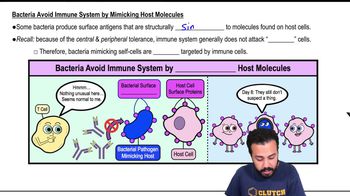
  • How do bacteria use host cell mimicry to avoid the immune system?

    Bacteria produce surface molecules that closely resemble host cell molecules, making them less likely to be targeted by immune cells.
  • Why does the immune system generally not attack cells that mimic host molecules?

    Due to central and peripheral tolerance, the immune system avoids attacking self cells or molecules that resemble self cells.
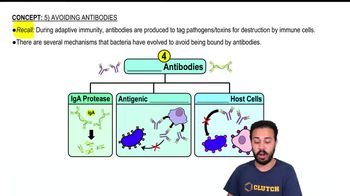
  • What are the three main mechanisms bacteria use to avoid antibodies?

    The three main mechanisms are producing IgA proteases, antigenic variation, and mimicking host cell molecules.
  • What role do plasma cells play in the adaptive immune response?

    Plasma cells produce antibodies that tag pathogens and toxins for destruction by other immune cells.
  • How does the production of IgA proteases affect the function of mucus membranes?

    It degrades the protective IgA antibodies in mucus, reducing the membrane's ability to tag and eliminate pathogens.
  • What is the outcome when a bacterium mimics host cell surface antigens?

    The immune system does not recognize the bacterium as foreign, allowing it to evade immune detection.
  • How does antigenic variation impact the effectiveness of antibody production?

    It reduces effectiveness because antibodies made for previous antigens cannot bind to newly altered antigens.
  • What is the significance of bacteria staying 'one step ahead' of antibody production?

    It allows bacteria to persist and proliferate in the host by avoiding destruction from the adaptive immune response.
  • Why is it important for the immune system to distinguish between self and non-self molecules?

    To prevent attacking the body's own cells, which could lead to autoimmune diseases, while still targeting pathogens.