Skip to main content
Microbiology
My Course
Learn
Exam Prep
AI Tutor
Study Guides
Textbook Solutions
Flashcards
Explore
Try the app
My Course
Learn
Exam Prep
AI Tutor
Study Guides
Textbook Solutions
Flashcards
Explore
Try the app
Back
Acids and Bases definitions
You can tap to flip the card.
Acid
You can tap to flip the card.
👆
Acid
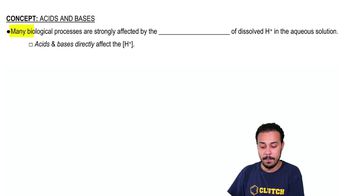
Any chemical that increases the concentration of hydrogen ions in an aqueous solution, impacting biological processes.
Track progress
Control buttons has been changed to "navigation" mode.
1/14
Related flashcards
Related practice
Recommended videos
Acids and Bases quiz
Acids and Bases
15 Terms
Acids and Bases
4. Water
4 problems
Topic
Brendan
pH Scale
4. Water
4 problems
Topic
Nicole
4. Water
7 topics
14 problems
Chapter
Nicole
03:44
Acids
19366
views
279
rank
01:29
Acids and Bases
21267
views
285
rank
03:48
Bases
18539
views
249
rank
Terms in this set (14)
Hide definitions
Acid
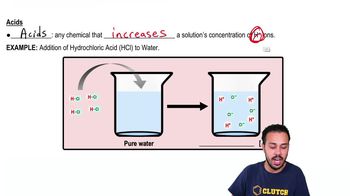
Any chemical that increases the concentration of hydrogen ions in an aqueous solution, impacting biological processes.
Base
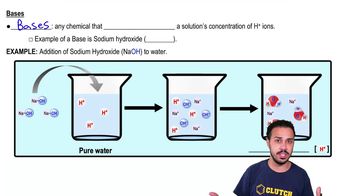
Any chemical that decreases the concentration of hydrogen ions in an aqueous solution, often by forming water.
Hydrogen Ion
A positively charged particle (H+) whose concentration determines the acidity or basicity of a solution.
Hydroxide Ion
A negatively charged particle (OH−) produced when bases dissociate in water, capable of neutralizing hydrogen ions.
Sodium Hydroxide
A classic base (NaOH) that dissociates in water to yield sodium ions and hydroxide ions, reducing hydrogen ion concentration.
Hydrochloric Acid
A strong acid (HCl) that dissociates in water to produce hydrogen ions and chloride ions, increasing solution acidity.
Chloride Ion
A negatively charged particle (Cl−) formed when hydrochloric acid dissociates in water.
Sodium Ion
A positively charged particle (Na+) produced when sodium hydroxide dissociates in water.
Aqueous Solution
A liquid mixture where water is the solvent, allowing acids and bases to dissociate and affect ion concentrations.
Concentration
The amount of a specific ion or molecule present in a given volume of solution, often indicated by brackets.
Dissociation
The process by which molecules split into ions when added to water, altering the solution's properties.
Water Molecule
A compound (H2O) formed when hydrogen ions combine with hydroxide ions, often as a result of base action.
Biological Process
A cellular or physiological activity that is influenced by the concentration of hydrogen ions in the environment.
Bracket Notation
A symbolic representation using brackets to indicate the concentration of a specific ion, such as [H+].
 BackBack
 03:44
03:44