Skip to main content
Microbiology
My Course
Learn
Exam Prep
AI Tutor
Study Guides
Textbook Solutions
Flashcards
Explore
Try the app
My Course
Learn
Exam Prep
AI Tutor
Study Guides
Textbook Solutions
Flashcards
Explore
Try the app
Back
Active Transport quiz
You can tap to flip the card.
What is the main requirement for active transport to move molecules across a membrane?
You can tap to flip the card.
👆
What is the main requirement for active transport to move molecules across a membrane?
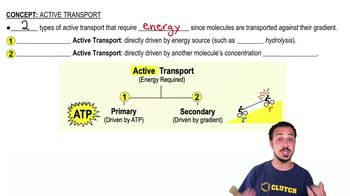
Active transport requires energy to move molecules against their concentration gradients, from areas of low to high concentration.
Track progress
Control buttons has been changed to "navigation" mode.
1/15
Related flashcards
Related practice
Recommended videos
Active Transport definitions
Active Transport
15 Terms
Active Transport
6. Cell Membrane & Transport
4 problems
Topic
Monica
ABC Transporters
6. Cell Membrane & Transport
3 problems
Topic
Monica
6. Cell Membrane & Transport - Part 1 of 2
7 topics
12 problems
Chapter
Monica
6. Cell Membrane & Transport - Part 2 of 2
8 topics
13 problems
Chapter
Brendan
06:57
Secondary Active Transport
17176
views
195
rank
02:37
Active Transport
20858
views
303
rank
02:53
Primary Active Transport
18854
views
257
rank
Terms in this set (15)
Hide definitions
What is the main requirement for active transport to move molecules across a membrane?
Active transport requires energy to move molecules against their concentration gradients, from areas of low to high concentration.
What are the two main types of active transport?
The two main types of active transport are primary active transport and secondary active transport.
How is primary active transport powered?
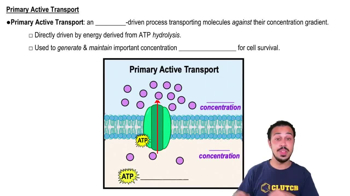
Primary active transport is powered directly by ATP hydrolysis.
What is the key difference between primary and secondary active transport?
Primary active transport uses ATP directly, while secondary active transport is powered by the concentration gradient of another molecule.
What membrane protein is a classic example of primary active transport?
The sodium-potassium pump is a classic example of primary active transport.
How many sodium and potassium ions does the sodium-potassium pump move per cycle, and in which directions?
The sodium-potassium pump exports three sodium ions out of the cell and imports two potassium ions into the cell per cycle.
Why is the sodium-potassium pump considered an antiporter?
It is considered an antiporter because it moves sodium and potassium ions in opposite directions across the membrane.
What is the role of ATP in the sodium-potassium pump?
ATP provides the energy required for the pump to move sodium and potassium ions against their concentration gradients.
How does secondary active transport obtain the energy needed to move molecules?
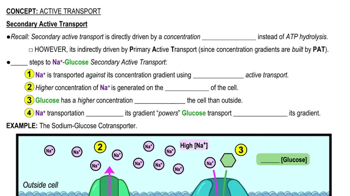
Secondary active transport uses the energy stored in the concentration gradient of another molecule, not directly from ATP.
What is a classic example of secondary active transport?
The sodium-glucose transporter is a classic example of secondary active transport.
How does the sodium-glucose transporter work?
It uses the energy from sodium ions moving down their concentration gradient to power the movement of glucose against its gradient.
How is the sodium gradient, used in secondary active transport, established?
The sodium gradient is established by primary active transport, specifically by the sodium-potassium pump using ATP.
Does secondary active transport directly use ATP? Explain.
No, secondary active transport does not directly use ATP; it relies on the gradient created by primary active transport.
What happens to the concentrations of sodium and potassium inside and outside the cell due to the sodium-potassium pump?
There is a low concentration of sodium and a high concentration of potassium inside the cell, and the opposite outside the cell.
Why is understanding both types of active transport important for cell biology?
Understanding both types is essential for comprehending how cells manage energy and maintain necessary concentration gradients for survival.
 BackBack
 06:57
06:57