Back

Antibodies definitions

Control buttons has been changed to "navigation" mode.
1/15
  • Antibody

    Y-shaped protein produced by plasma cells, capable of binding specifically to antigens and triggering immune responses.
  • Immunoglobulin

    Alternate name for a Y-shaped protein that binds antigens, abbreviated as IG and classified into five main types.
  • Plasma Cell

    Specialized immune cell responsible for synthesizing and secreting Y-shaped antigen-binding proteins.
  • Antigen

    Foreign molecule recognized and bound by specific Y-shaped immune proteins, initiating a defense response.
  • Polypeptide Chain

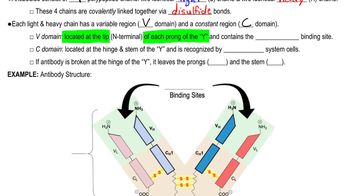
    Linear sequence of amino acids forming part of the Y-shaped immune protein, present as two identical light and two heavy forms.
  • Light Chain

    Smaller, identical pair of amino acid sequences in the Y-shaped immune protein, contributing to antigen binding.
  • Heavy Chain

    Larger, identical pair of amino acid sequences in the Y-shaped immune protein, forming the main structure.
  • Disulfide Bond

    Covalent linkage between sulfur atoms of cysteine residues, stabilizing the structure of the Y-shaped immune protein.
  • Variable Domain

    Region at the tip of each Y-shaped protein prong, containing the antigen-binding site and differing among molecules.
  • Constant Domain

    Region forming the stem and hinge of the Y-shaped protein, recognized by immune cells and remaining unchanged.
  • FAB Region

    Top portion of the Y-shaped protein containing antigen-binding sites, generated by splitting at the hinge.
  • FC Region

    Bottom portion of the Y-shaped protein containing the constant region, important for immune cell recognition.
  • Antigen-Binding Site

    Specific location at the tip of the Y-shaped protein where foreign molecules are recognized and attached.
  • Gene Rearrangement

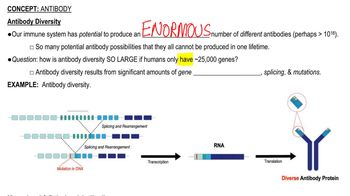
    Process altering DNA segments to create diverse Y-shaped immune proteins, enabling recognition of many antigens.
  • Mutation

    Change in the genetic code that can result in new variants of Y-shaped immune proteins, increasing diversity.