Back

ATP quiz

Control buttons has been changed to "navigation" mode.
1/15
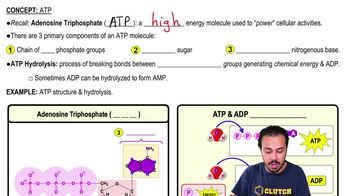
  • What does ATP stand for and what are its main components?

    ATP stands for adenosine triphosphate and is composed of adenosine (a pentose sugar and adenine base) and three phosphate groups.
  • How do cells extract energy from ATP?

    Cells extract energy from ATP through ATP hydrolysis, which breaks bonds between phosphate groups and releases energy.
  • What is produced when ATP is hydrolyzed?

    ATP hydrolysis produces ADP (adenosine diphosphate), a free phosphate group, and releases energy.
  • What does the 'tri' in triphosphate indicate about ATP's structure?

    'Tri' indicates that ATP contains a chain of three phosphate groups.
  • What are the two components of the adenosine part of ATP?

    The adenosine part consists of a pentose sugar and an adenine nitrogenous base.
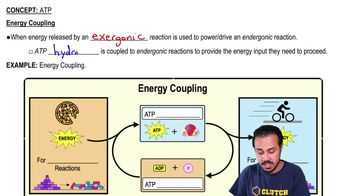
  • What is energy coupling in cellular metabolism?

    Energy coupling is when energy released by an exergonic reaction, such as ATP hydrolysis, is used to drive an endergonic reaction that requires energy input.
  • How is the energy from food molecules used by cells?

    Energy from food molecules is released through exergonic reactions and converted into ATP, which powers cellular activities.
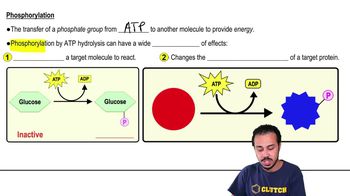
  • What is phosphorylation?

    Phosphorylation is the transfer of a phosphate group from ATP to another molecule, often providing energy or altering the molecule's function.
  • What can phosphorylation do to a target molecule?

    Phosphorylation can activate or inactivate a target molecule and may change its structure or function.
  • What happens to ADP during further hydrolysis?

    ADP can be hydrolyzed to form AMP (adenosine monophosphate) and another free phosphate group, releasing energy.
  • What is the role of ATP hydrolysis in muscle contraction or movement?

    ATP hydrolysis provides the energy needed for muscle contraction and movement, such as riding a bicycle.
  • What are the reactants required for ATP hydrolysis?

    ATP hydrolysis requires ATP and water as reactants.
  • How does phosphorylation affect proteins?

    Phosphorylation can change a protein's conformation (shape), which may alter its function.
  • What is the difference between ATP, ADP, and AMP?

    ATP has three phosphate groups, ADP has two, and AMP has one phosphate group.
  • Why is ATP considered a high-energy molecule?

    ATP is considered high-energy because breaking its phosphate bonds releases significant energy that can be used for cellular processes.