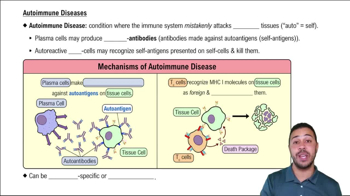
An autoimmune disease is a condition where the immune system mistakenly attacks the body's own self tissues instead of pathogens.
What are the two main types of immunity involved in autoimmune diseases?
Autoimmune diseases can involve defects in humoral immunity (autoantibodies) or cell-mediated immunity (autoreactive T cells).
What percentage of the human population is affected by autoimmune diseases?
Autoimmune diseases affect approximately 5-10% of the human population.
What is the difference between organ-specific and systemic autoimmune diseases?
Organ-specific autoimmune diseases affect one particular region of the body, while systemic autoimmune diseases impact multiple organs throughout the body.
How do plasma cells contribute to autoimmune diseases?
Plasma cells can produce autoantibodies that bind to autoantigens on self tissues, leading to their attack.
What role do autoreactive cytotoxic T cells play in autoimmune diseases?
Autoreactive cytotoxic T cells recognize self antigens presented on MHC class I molecules and destroy self cells.
What is Graves' disease and how does it affect the body?
Graves' disease is an organ-specific autoimmune disorder where autoantibodies bind hormone receptors on thyroid cells, overstimulating thyroid hormone production.
How does myasthenia gravis impact muscle function?
Myasthenia gravis occurs when autoantibodies block receptors at neuromuscular junctions, preventing muscle contractions and reducing muscular activity.
What is the main target in multiple sclerosis (MS)?
In MS, the immune system attacks myelin, the protective insulating layer on nerve axons, disrupting nervous system communication.
What happens in type 1 diabetes mellitus due to autoimmunity?
Type 1 diabetes mellitus is caused by T cell-mediated destruction of insulin-secreting cells in the pancreas, reducing insulin production and glucose regulation.
What is the mechanism behind systemic lupus erythematosus (SLE)?
SLE involves autoantibodies binding to various autoantigens, including nuclear components like DNA, forming immune complexes that damage multiple organs.
How does rheumatoid arthritis differ from osteoarthritis?
Rheumatoid arthritis is caused by immune complexes deposited in joints, leading to inflammation and pain, while osteoarthritis results from mechanical wear and tear.
What are three major contributing factors to autoimmune diseases?
The three major contributing factors are genetics, environmental triggers (such as infections), and immune regulation defects.
How can infections contribute to the development of autoimmune diseases?
Some pathogens mimic host antigens, and immune responses against them may also attack similar self antigens, leading to autoimmunity.
What is notable about the prevalence of autoimmune diseases in women?
About 80% of autoimmune disease cases occur in women, but the exact reasons for this are still not fully understood.
 Back
Back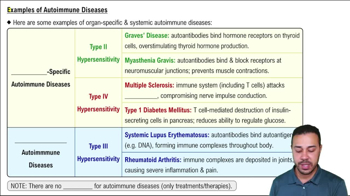
 03:36
03:36