Back

Bacterial Pathogenesis quiz

Control buttons has been changed to "navigation" mode.
1/15
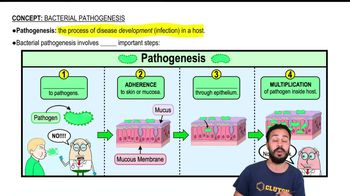
  • What are the four main steps of bacterial pathogenesis?

    The four main steps are exposure to the pathogen, adherence to the host, invasion into host cells or tissues, and multiplication or colonization inside the host.
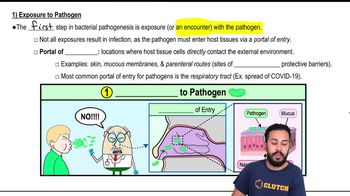
  • What is meant by 'exposure to the pathogen' in bacterial pathogenesis?

    Exposure refers to the host coming into contact with the pathogen, often through portals of entry like the skin, mucous membranes, or respiratory tract.
  • What is a portal of entry, and give two examples?

    A portal of entry is a specific location where pathogens can enter the body, such as the skin or respiratory tract.
  • Why is adherence a critical step in bacterial pathogenesis?

    Adherence is critical because if the pathogen cannot attach to host cells, it will be eliminated and unable to cause disease.
  • What are adhesins and where are they commonly found on bacteria?

    Adhesins are molecules on the surface of pathogens that bind to specific host cell receptors, and they are commonly found on bacterial pili, fimbriae, or flagella.
  • How does the specificity of adhesin-receptor binding affect infection?

    The specificity determines which cell types and tissues a pathogen can infect, as only compatible adhesins and receptors allow adherence and subsequent infection.
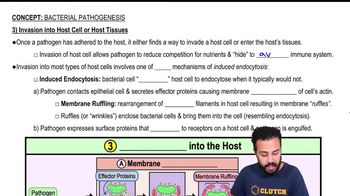
  • Describe one mechanism by which bacteria invade host cells.

    One mechanism is induced endocytosis, where bacteria secrete effector proteins that cause host cell membrane ruffling, allowing the bacteria to be engulfed.
  • What advantage does invasion into host cells provide to bacteria?

    Invasion allows bacteria to avoid the immune system and reduce competition for nutrients, helping them survive and multiply.
  • What is the difference between membrane ruffling and standard endocytosis during bacterial invasion?

    Membrane ruffling involves actin rearrangement and membrane wrinkling to engulf bacteria, while standard endocytosis is the normal engulfment process triggered by surface protein-receptor binding.
  • What happens during the multiplication or colonization step of bacterial pathogenesis?

    The pathogen replicates inside the host, which can lead to infection and damage to the host.
  • What is a local infection?

    A local infection is confined to a small, specific area of the body, usually near the portal of entry.
  • How does a focal infection differ from a local infection?

    A focal infection starts as a local infection but then spreads to other parts of the body, often via the bloodstream.
  • What characterizes a systemic infection?

    A systemic infection is one that spreads throughout the entire body, affecting multiple organs or tissues.
  • Why do not all exposures to pathogens result in infection?

    Not all exposures result in infection because the pathogen must enter through a proper portal of entry and successfully adhere to host cells.
  • What role do host cell receptors play in bacterial adherence?

    Host cell receptors provide specific binding sites for bacterial adhesins, determining whether a pathogen can attach and initiate infection.