Back

Biofilms quiz

Control buttons has been changed to "navigation" mode.
1/15
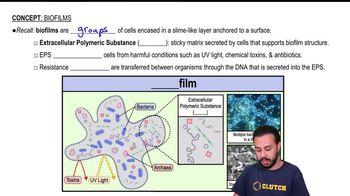
  • What is a biofilm?

    A biofilm is a community of cells encased in a slime-like layer called the extracellular polymeric substance (EPS) that is anchored to a surface.
  • What does EPS stand for in the context of biofilms?

    EPS stands for extracellular polymeric substance, which is a sticky matrix secreted by cells in a biofilm.
  • What is the main function of the extracellular polymeric substance (EPS) in a biofilm?

    The EPS protects cells within the biofilm from harmful conditions such as UV light, chemical toxins, and antibiotics.
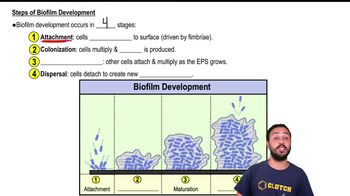
  • How many stages are there in biofilm development?

    There are four stages in biofilm development: attachment, colonization, maturation, and dispersal.
  • What is the first stage of biofilm development and what happens during it?

    The first stage is attachment, where cells adhere to a surface using structures like fimbriae.
  • What occurs during the colonization stage of biofilm development?

    During colonization, attached cells multiply and begin producing the EPS, forming the initial biofilm structure.
  • Describe what happens in the maturation stage of biofilm development.

    In maturation, the biofilm grows and diversifies as more cells attach and contribute to the EPS.
  • What is the dispersal stage in biofilm development?

    Dispersal is when cells detach from the biofilm and EPS to move to new locations and potentially form new biofilms.
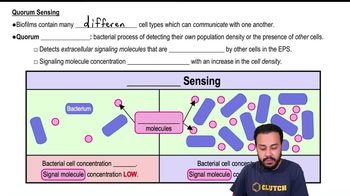
  • What is quorum sensing?

    Quorum sensing is a process where cells in a biofilm communicate chemically to detect population density and the presence of other cells.
  • How do cells in a biofilm communicate with each other?

    Cells communicate using chemical signaling molecules that are released into the EPS and detected by other cells.
  • What happens to the concentration of signaling molecules as cell density increases in a biofilm?

    The concentration of signaling molecules increases as cell density increases.
  • How does quorum sensing help cells in a biofilm?

    Quorum sensing allows cells to detect their own population density and that of neighboring cells, influencing behaviors like replication and biofilm formation.
  • What role do fimbriae play in biofilm formation?

    Fimbriae are bacterial structures that help cells attach to surfaces during the initial stage of biofilm development.
  • Can resistance genes be transferred within a biofilm? If so, how?

    Yes, resistance genes can be transferred between organisms through DNA secreted into the EPS of the biofilm.
  • Why are cells in a biofilm more protected from antibiotics than free-living cells?

    Cells in a biofilm are more protected because the EPS acts as a barrier, reducing the penetration of antibiotics and other harmful agents.