Back

Cell Communication: Cytokines quiz

Control buttons has been changed to "navigation" mode.
1/15
  • What are cytokines and what is their primary function in cell communication?

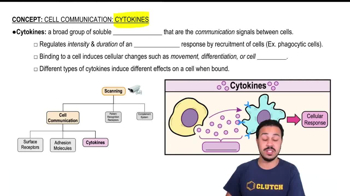
    Cytokines are a broad group of soluble proteins that serve as communication signals between cells, regulating immune responses by inducing cellular changes.
  • How do cytokines regulate the intensity and duration of an immune response?

    Cytokines can recruit immune cells, induce movement, differentiation, or cell death, thereby controlling the immune response's strength and length.
  • What cellular changes can cytokines induce when they bind to a cell?

    Cytokines can induce movement, differentiation into another cell type, or cell death depending on the cytokine type.
  • What is chemotaxis and which cytokine type is responsible for it?

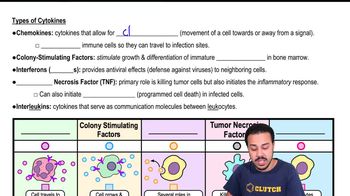
    Chemotaxis is the movement of cells toward or away from a chemical signal, and chemokines are the cytokines responsible for this process.
  • How do chemokines help the immune system respond to infection?

    Chemokines recruit immune cells to infection sites, enabling them to eliminate microbes present there.
  • What is the function of colony stimulating factors in the immune system?

    Colony stimulating factors stimulate the growth and differentiation of immature leukocytes in the bone marrow.
  • How do colony stimulating factors influence leukocyte development?

    The type of colony stimulating factor released and detected dictates which leukocyte types stem cells will grow and differentiate into.
  • What are interferons and what is their main role?

    Interferons (IFNs) are cytokines that provide antiviral effects, helping neighboring cells defend against viral infections.
  • What is the primary function of tumor necrosis factors (TNF)?

    Tumor necrosis factors initiate inflammation and apoptosis, and were originally discovered for their role in killing tumor cells.
  • What is apoptosis and how is it related to tumor necrosis factors?

    Apoptosis is programmed cell death, and TNF can initiate apoptosis in infected cells.
  • What are interleukins and what is their main function?

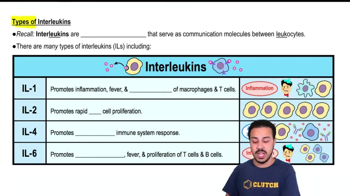
    Interleukins are cytokines that facilitate communication between leukocytes, with a wide variety of effects on immune responses.
  • What does the abbreviation 'IL' stand for in cytokine terminology?

    'IL' stands for interleukin, a type of cytokine involved in leukocyte communication.
  • What are the main functions of interleukin 1 (IL-1)?

    IL-1 promotes inflammation, fever, and activation of macrophages and T cells.
  • How does interleukin 2 (IL-2) contribute to immune responses?

    IL-2 promotes rapid proliferation of T cells, aiding in immune cell expansion.
  • Which interleukin is important for antibody immune response and adaptive immunity?

    Interleukin 4 (IL-4) is important for promoting antibody immune response and adaptive immunity.