Skip to main content
Microbiology
My Course
Learn
Exam Prep
AI Tutor
Study Guides
Textbook Solutions
Flashcards
Explore
Try the app
My Course
Learn
Exam Prep
AI Tutor
Study Guides
Textbook Solutions
Flashcards
Explore
Try the app
Back
Conjugation: F Plasmids definitions
You can tap to flip the card.
Conjugative Plasmid
You can tap to flip the card.
👆
Conjugative Plasmid
A circular DNA molecule capable of directing its own transfer to a recipient cell during conjugation.
Track progress
Control buttons has been changed to "navigation" mode.
1/13
Related flashcards
Related practice
Recommended videos
Conjugation: F Plasmids quiz
Conjugation: F Plasmids
15 Terms
Conjugation: F Plasmids
16. Microbial Genetics
4 problems
Topic
Brendan
Conjugation: Hfr & F' Cells
16. Microbial Genetics
3 problems
Topic
Nicole
16. Microbial Genetics - Part 1 of 2
9 topics
14 problems
Chapter
Monica
16. Microbial Genetics - Part 2 of 2
8 topics
13 problems
Chapter
Nicole
05:57
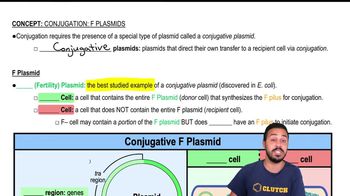
F Plasmids
1913
views
22
rank
04:12
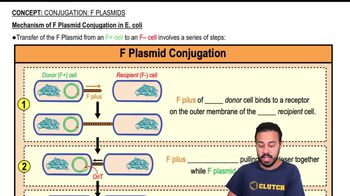
Mechanism of F Plasmid Conjugation in E. coli
1489
views
16
rank
1
comments
Terms in this set (13)
Hide definitions
Conjugative Plasmid
A circular DNA molecule capable of directing its own transfer to a recipient cell during conjugation.
F Plasmid
A fertility-associated DNA element in E. coli that enables donor cells to initiate and direct conjugation.
F+ Cell
A bacterial donor cell containing the complete fertility plasmid, able to synthesize a pilus and initiate conjugation.
F- Cell
A bacterial recipient cell lacking the complete fertility plasmid and unable to initiate conjugation.
F Pilus
A surface structure produced by donor cells, responsible for attaching to and drawing recipient cells closer during conjugation.
Donor Cell
A bacterial cell that provides genetic material to another cell during the conjugation process.
Recipient Cell
A bacterial cell that receives genetic material from a donor during conjugation, becoming capable of further transfer.
tra Region
A segment of the fertility plasmid containing genes essential for pilus formation and the conjugation process.
oriT Region
The specific site on the fertility plasmid where DNA transfer and replication begin during conjugation.
Replication
The process by which a single DNA strand is copied to form a complete plasmid in the recipient cell during transfer.
Outer Membrane
The external boundary of a bacterial cell to which the pilus attaches during the initial stage of conjugation.
Single Strand Transfer
The movement of one DNA strand from the donor to the recipient, which is then used as a template for synthesis.
E. coli
A model bacterial species in which the fertility plasmid and its conjugation mechanism were first characterized.
 BackBack
 05:57
05:57