Skip to main content
Microbiology
My Course
Learn
Exam Prep
AI Tutor
Study Guides
Textbook Solutions
Flashcards
Explore
Try the app
My Course
Learn
Exam Prep
AI Tutor
Study Guides
Textbook Solutions
Flashcards
Explore
Try the app
Back
Conjugation: F Plasmids quiz
You can tap to flip the card.
What is a conjugative plasmid?
You can tap to flip the card.
👆
What is a conjugative plasmid?
A conjugative plasmid is a plasmid capable of directing its own transfer to a recipient cell via conjugation.
Track progress
Control buttons has been changed to "navigation" mode.
1/15
Related flashcards
Related practice
Recommended videos
Conjugation: F Plasmids definitions
Conjugation: F Plasmids
13 Terms
Conjugation: F Plasmids
16. Microbial Genetics
4 problems
Topic
Brendan
Conjugation: Hfr & F' Cells
16. Microbial Genetics
3 problems
Topic
Nicole
16. Microbial Genetics - Part 1 of 2
9 topics
14 problems
Chapter
Monica
16. Microbial Genetics - Part 2 of 2
8 topics
13 problems
Chapter
Nicole
05:57
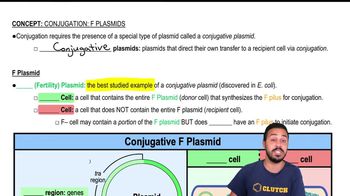
F Plasmids
1913
views
22
rank
04:12
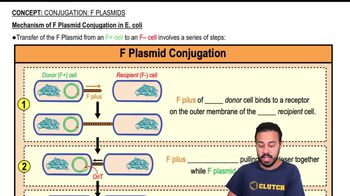
Mechanism of F Plasmid Conjugation in E. coli
1489
views
16
rank
1
comments
Terms in this set (15)
Hide definitions
What is a conjugative plasmid?
A conjugative plasmid is a plasmid capable of directing its own transfer to a recipient cell via conjugation.
What does the 'F' in F plasmid stand for?
The 'F' in F plasmid stands for fertility.
Which type of cell contains the entire F plasmid?
F+ cells contain the entire F plasmid.
What structure do F+ cells synthesize to initiate conjugation?
F+ cells synthesize an F pilus to initiate conjugation.
What is the role of F- cells in conjugation?
F- cells serve as recipient cells in conjugation because they lack the entire F plasmid.
Can F- cells initiate conjugation? Why or why not?
No, F- cells cannot initiate conjugation because they do not have an F pilus.
What is the tra region on the F plasmid responsible for?
The tra region contains genes required for conjugation, including those that create the F pilus.
What is the function of the oriT region on the F plasmid?
The oriT region serves as the origin of replication during conjugation.
Describe the first step in F plasmid conjugation.
The F pilus of the F+ donor cell binds to a receptor on the outer membrane of the F- recipient cell.
What happens after the F pilus binds to the F- cell?
The F pilus retracts, pulling the two cells closer together.
At what region is the F plasmid cut during conjugation?
The F plasmid is cut at the oriT region.
What is transferred from the F+ cell to the F- cell during conjugation?
A single strand of the F plasmid is transferred from the F+ cell to the F- cell.
How does the recipient cell become F+ after conjugation?
The single strand of the F plasmid is replicated in the recipient cell, forming a complete F plasmid and converting it to F+.
What is the outcome for both cells after F plasmid conjugation is complete?
Both the donor and recipient cells become F+ cells, each with a full copy of the F plasmid.
Why is the spread of the F plasmid significant in bacterial populations?
The spread of the F plasmid allows more cells to become F+ and capable of further conjugation, facilitating genetic exchange.
 BackBack
 05:57
05:57