Skip to main content
Microbiology
My Course
Learn
Exam Prep
AI Tutor
Study Guides
Textbook Solutions
Flashcards
Explore
Try the app
My Course
Learn
Exam Prep
AI Tutor
Study Guides
Textbook Solutions
Flashcards
Explore
Try the app
Back
Covalent Bonds quiz
You can tap to flip the card.
What is a covalent bond?
You can tap to flip the card.
👆
What is a covalent bond?
A covalent bond is an interaction between two atoms that results from the sharing of electrons.
Track progress
Control buttons has been changed to "navigation" mode.
1/15
Related flashcards
Related practice
Recommended videos
Covalent Bonds definitions
Covalent Bonds
15 Terms
Covalent Bonds
3. Chemical Principles of Microbiology
4 problems
Topic
Monica
Noncovalent Bonds
3. Chemical Principles of Microbiology
3 problems
Topic
Monica
3. Chemical Principles of Microbiology
7 topics
12 problems
Chapter
Nicole
04:28
Covalent Bonds
28079
views
548
rank
06:51
Polar Covalent Bonds
22220
views
373
rank
06:41
Nonpolar Covalent Bonds
23355
views
429
rank
Terms in this set (15)
Hide definitions
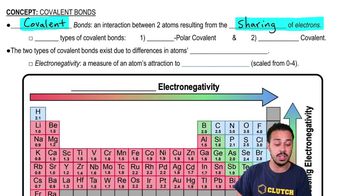
What is a covalent bond?
A covalent bond is an interaction between two atoms that results from the sharing of electrons.
What does the term 'covalent' mean in chemistry?
The term 'covalent' refers to the sharing of electrons between atoms.
What are the two main types of covalent bonds?
The two main types of covalent bonds are nonpolar covalent bonds and polar covalent bonds.
What is electronegativity?
Electronegativity is a measure of an atom's attraction to electrons, or how hard it pulls on electrons.
How does electronegativity change across the periodic table?
Electronegativity increases from left to right and from bottom to top on the periodic table.
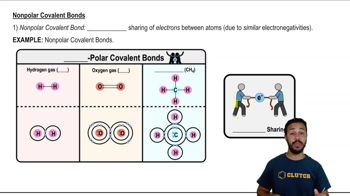
What characterizes a nonpolar covalent bond?
A nonpolar covalent bond is characterized by the equal sharing of electrons between atoms.
Why do nonpolar covalent bonds share electrons equally?
Nonpolar covalent bonds share electrons equally because the atoms involved have similar or identical electronegativities.
Give an example of a molecule with nonpolar covalent bonds.
Hydrogen gas (H2), oxygen gas (O2), and methane (CH4) are examples of molecules with nonpolar covalent bonds.
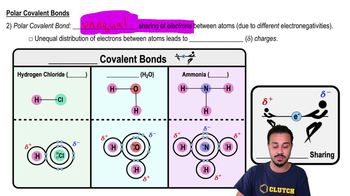
What characterizes a polar covalent bond?
A polar covalent bond is characterized by the unequal sharing of electrons between atoms.
Why do polar covalent bonds share electrons unequally?
Polar covalent bonds share electrons unequally because the atoms involved have different electronegativities.
What is the result of unequal sharing of electrons in polar covalent bonds?
Unequal sharing of electrons leads to partial charges on the atoms involved, with the more electronegative atom gaining a partial negative charge.
What symbol is used to indicate a partial charge in polar covalent bonds?
The Greek symbol delta (δ) is used to indicate a partial charge.
Give an example of a molecule with polar covalent bonds.
Water (H2O), hydrogen chloride (HCl), and ammonia (NH3) are examples of molecules with polar covalent bonds.
Which atom is more electronegative: oxygen or hydrogen?
Oxygen is much more electronegative than hydrogen.
What happens to the electron distribution in a polar covalent bond?
In a polar covalent bond, electrons spend more time with the more electronegative atom, creating partial negative and positive charges.
 BackBack
 04:28
04:28