Skip to main content
Microbiology
My Course
Learn
Exam Prep
AI Tutor
Study Guides
Textbook Solutions
Flashcards
Explore
Try the app
My Course
Learn
Exam Prep
AI Tutor
Study Guides
Textbook Solutions
Flashcards
Explore
Try the app
Back
Differential Staining quiz
You can tap to flip the card.
What is the main purpose of differential staining in microbiology?
You can tap to flip the card.
👆
What is the main purpose of differential staining in microbiology?
Differential staining is used to distinguish or differentiate different groups of bacteria using multiple dyes.
Track progress
Control buttons has been changed to "navigation" mode.
1/15
Related flashcards
Related practice
Recommended videos
Differential Staining definitions
Differential Staining
12 Terms
Differential Staining
9. Microscopes
4 problems
Topic
Brendan
Other Types of Staining
9. Microscopes
3 problems
Topic
Nicole
9. Microscopes - Part 1 of 3
6 topics
12 problems
Chapter
Nicole
9. Microscopes - Part 2 of 3
8 topics
10 problems
Chapter
Nicole
9. Microscopes - Part 3 of 3
1 topic
3 problems
Chapter
04:07
Differential Staining
3138
views
43
rank
Terms in this set (15)
Hide definitions
What is the main purpose of differential staining in microbiology?
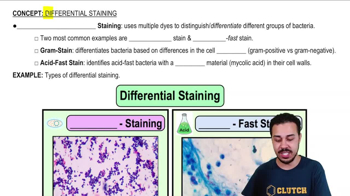
Differential staining is used to distinguish or differentiate different groups of bacteria using multiple dyes.
Name the two most common types of differential stains.
The two most common differential stains are the Gram stain and the acid-fast stain.
On what basis does the Gram stain differentiate bacteria?
The Gram stain differentiates bacteria based on differences in their cell wall composition.
What color do gram positive bacteria appear after Gram staining?
Gram positive bacteria appear purple after Gram staining.
What color do gram negative bacteria appear after Gram staining?
Gram negative bacteria appear pink after Gram staining.
Give an example of a gram negative bacterium.
Escherichia coli is an example of a gram negative bacterium.
Give an example of a gram positive bacterium.
Staphylococcus aureus is an example of a gram positive bacterium.
What is the main feature identified by the acid-fast stain?
The acid-fast stain identifies bacteria with mycolic acid, a waxy material, in their cell walls.
Which bacterium is a classic example of an acid-fast organism?
Mycobacterium tuberculosis is a classic example of an acid-fast bacterium.
What color do acid-fast bacteria appear after acid-fast staining?
Acid-fast bacteria appear dark purple after acid-fast staining.
How do non-acid-fast bacteria appear after acid-fast staining?
Non-acid-fast bacteria do not take on the dark purple color after acid-fast staining.
What is mycolic acid and why is it important in differential staining?
Mycolic acid is a waxy material found in the cell walls of acid-fast bacteria, making them identifiable by the acid-fast stain.
Why are differential stains important in microbiology?
Differential stains are important because they help group bacteria based on specific features, aiding in identification and classification.
What does the presence of a purple color in a Gram stain indicate about a bacterium?
A purple color in a Gram stain indicates the bacterium is gram positive.
What does the presence of a pink color in a Gram stain indicate about a bacterium?
A pink color in a Gram stain indicates the bacterium is gram negative.
 BackBack
 04:07
04:07