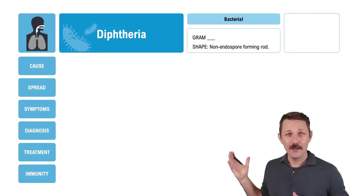
What type of bacteria causes diphtheria and how is it described morphologically?
Diphtheria is caused by Corynebacterium diphtheriae, which is a gram-positive, non-endospore-forming, club-shaped rod.
How is the exotoxin responsible for diphtheria produced?
The exotoxin is produced only when Corynebacterium diphtheriae is lysogenized by a bacteriophage that carries the exotoxin gene.
What is the main mechanism of action of the diphtheria exotoxin?
The exotoxin inhibits protein synthesis in host cells, leading to cell death.
What is a pseudomembrane in diphtheria and why is it dangerous?
A pseudomembrane is a layer of fibrin and dead cells that forms in the airway and can obstruct breathing, potentially causing suffocation.
How is diphtheria primarily transmitted?
Diphtheria is mainly transmitted via respiratory droplets during close contact.
What are some classic symptoms of respiratory diphtheria?
Classic symptoms include sore throat, fever, swollen neck (bull neck), weakness, and the formation of a pseudomembrane in the throat.
Why are skin infections caused by Corynebacterium diphtheriae less dangerous than respiratory infections?
Skin infections are less dangerous because the exotoxin is not easily absorbed through the skin, making systemic effects rare.
What laboratory methods are used to diagnose diphtheria?
Diagnosis involves bacterial culture on selective and differential media, immunoassays like the ELIC test, and PCR for the exotoxin gene.
Why is it important to confirm both the presence of Corynebacterium diphtheriae and the exotoxin gene in diagnosis?
Both are necessary because only bacteria infected with the phage carrying the exotoxin gene can cause severe disease.
What is the role of antitoxin in the treatment of diphtheria?
Antitoxin is used to neutralize the exotoxin already circulating in the body, preventing further tissue damage.
Which antibiotics are commonly used to treat diphtheria?
Erythromycin and penicillin are commonly used antibiotics for treating diphtheria.
What type of vaccine is used to prevent diphtheria and what does it target?
The DTaP vaccine is a toxoid vaccine that targets the diphtheria exotoxin, not the bacteria itself.
At what age is the DTaP vaccine typically first administered to children?
The DTaP vaccine is typically first given to children at around two months of age.
What is the difference between DTaP, Tdap, and Td vaccines?
DTaP is for children and includes diphtheria, tetanus, and acellular pertussis; Tdap and Td are booster vaccines for older children and adults, with Td not including pertussis.
Why is diphtheria rare in the United States today?
Diphtheria is rare due to widespread vaccination with the DTaP vaccine, which provides immunity against the exotoxin.
 Back
Back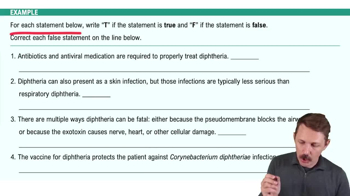
 03:53
03:53