Back

Effects of the Complement System quiz

Control buttons has been changed to "navigation" mode.
1/15
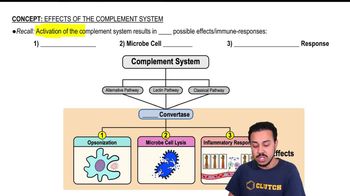
  • What are the three main effects of complement system activation?

    The three main effects are opsonization, microbe cell lysis, and the inflammatory response.
  • What enzyme is formed by all three complement activation pathways?

    All three pathways lead to the formation of C3 convertase.
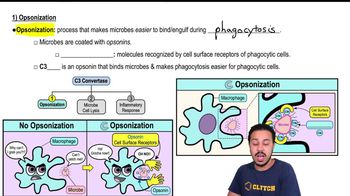
  • What is opsonization in the context of the complement system?

    Opsonization is the process of coating microbes with opsonins to make them easier for phagocytes to bind and engulf.
  • Which complement protein acts as an opsonin during opsonization?

    C3b acts as an opsonin by binding to the surface of microbes.
  • How does opsonization affect phagocytosis?

    Opsonization makes phagocytosis easier and more efficient for phagocytic cells.
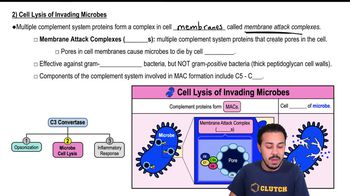
  • What is a membrane attack complex (MAC)?

    A MAC is a structure formed by complement proteins that creates pores in microbe membranes, leading to cell lysis.
  • Which complement proteins are involved in forming the membrane attack complex?

    Complement proteins C5 through C9 are involved in forming the MAC.
  • Why are membrane attack complexes more effective against gram-negative bacteria?

    MACs are more effective against gram-negative bacteria because they target the outer lipid membrane, which is absent in gram-positive bacteria.
  • What happens to microbes when a membrane attack complex forms in their membrane?

    The formation of a MAC causes pores in the membrane, leading to cell lysis and death of the microbe.
  • What triggers the inflammatory response in the complement system?

    The inflammatory response is triggered by complement proteins C3a and C5a.
  • What changes do C3a and C5a induce in blood vessel epithelial cells?

    C3a and C5a cause dilation of blood vessel epithelial cells, allowing immune cells to access the infection site.
  • What effect do C3a and C5a have on mast cells?

    C3a and C5a cause mast cells to degranulate, releasing histamine and cytokines that promote inflammation.
  • What are the characteristic signs of inflammation?

    Inflammation is characterized by swelling, redness, heat, pain, and sometimes loss of function.
  • How does the inflammatory response help eliminate microbes?

    It promotes blood vessel dilation and immune cell migration to the infection site, aiding in microbe elimination.
  • What is the role of histamine and cytokines released during the inflammatory response?

    Histamine and cytokines promote inflammation, which helps contain and eliminate microbes and restore tissue damage.