Skip to main content
Microbiology
My Course
Learn
Exam Prep
AI Tutor
Study Guides
Textbook Solutions
Flashcards
Explore
Try the app
My Course
Learn
Exam Prep
AI Tutor
Study Guides
Textbook Solutions
Flashcards
Explore
Try the app
Back
Electromagnetic Spectrum quiz
You can tap to flip the card.
What is a photon?
You can tap to flip the card.
👆
What is a photon?
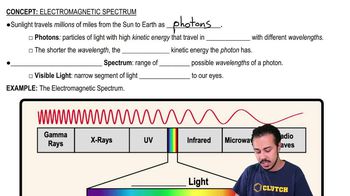
A photon is a particle of light with high kinetic energy that travels in waves of varying wavelengths.
Track progress
Control buttons has been changed to "navigation" mode.
1/15
Related flashcards
Related practice
Recommended videos
Electromagnetic Spectrum definitions
Electromagnetic Spectrum
13 Terms
Electromagnetic Spectrum
13. Photosynthesis
1 problem
Topic
Nicole
Pigments of Photosynthesis
13. Photosynthesis
4 problems
Topic
Brendan
13. Photosynthesis
9 topics
13 problems
Chapter
Nicole
04:29
Electromagnetic Spectrum
12950
views
140
rank
Terms in this set (15)
Hide definitions
What is a photon?
A photon is a particle of light with high kinetic energy that travels in waves of varying wavelengths.
How does the energy of a photon relate to its wavelength?
The energy of a photon is inversely related to its wavelength; shorter wavelengths have higher energy.
What is the electromagnetic spectrum?
The electromagnetic spectrum is the range of all possible wavelengths that photons can have.
What is visible light in the context of the electromagnetic spectrum?
Visible light is a small, narrow segment of the electromagnetic spectrum that can be detected by the human eye as colors.
What is the wavelength range of visible light?
Visible light spans wavelengths from about 380 nanometers (nm) to about 750 nm.
How do chloroplasts relate to photons?
Chloroplasts can capture the energy contained within photons.
What happens to photon energy as wavelength increases?
As wavelength increases, photon energy decreases.
Which part of the electromagnetic spectrum has the shortest wavelengths?
Gamma rays have the shortest wavelengths in the electromagnetic spectrum.
Which part of the electromagnetic spectrum has the longest wavelengths?
Radio waves have the longest wavelengths in the electromagnetic spectrum.
How do humans perceive colors?
Humans perceive colors within the visible light range of the electromagnetic spectrum.
What is the relationship between wavelength and energy in the electromagnetic spectrum?
Shorter wavelengths correspond to higher energy, while longer wavelengths correspond to lower energy.
Why is visible light important in this course?
The course will focus mainly on visible light, exploring its properties and applications.
How does sunlight reach Earth?
Sunlight travels millions of miles from the sun to Earth as photons.
What does 'nm' stand for in the context of light wavelengths?
'nm' stands for nanometers, a unit used to measure the wavelength of light.
What segment of the electromagnetic spectrum can human eyes detect?
Human eyes can detect only the visible light segment of the electromagnetic spectrum.
 BackBack
 04:29
04:29