Back

Electron Transport Chain quiz

Control buttons has been changed to "navigation" mode.
1/15
  • Where is the electron transport chain (ETC) located in eukaryotic cells?

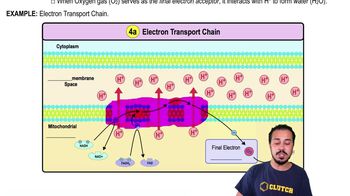
    The ETC is located in the inner mitochondrial membrane of eukaryotic cells.
  • What is the main function of the electron transport chain in cellular respiration?

    The ETC harnesses energy from electrons to create a hydrogen ion gradient across the inner mitochondrial membrane.
  • Which molecules donate electrons to the electron transport chain?

    NADH and FADH2 donate electrons to the electron transport chain.
  • What is the final electron acceptor in the electron transport chain during aerobic respiration?

    Oxygen (O2) is the final electron acceptor in the ETC during aerobic respiration.
  • What byproduct is formed when oxygen accepts electrons at the end of the ETC?

    Water (H2O) is formed as a byproduct when oxygen accepts electrons and reacts with hydrogen ions.
  • What is the purpose of pumping hydrogen ions into the intermembrane space during the ETC?

    Pumping hydrogen ions creates a concentration gradient that stores potential energy for ATP synthesis.
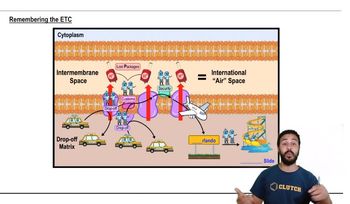
  • In the airport analogy, what do NADH and FADH2 represent?

    NADH and FADH2 are compared to taxis carrying electron 'passengers' to the ETC.
  • Where do electrons from NADH enter the electron transport chain compared to FADH2?

    Electrons from NADH enter the ETC at an earlier point than those from FADH2.
  • What does the intermembrane space represent in the airport analogy?

    The intermembrane space is likened to 'international airspace' in the airport analogy.
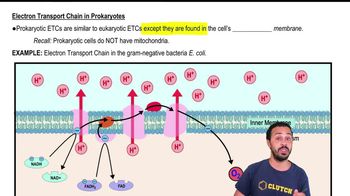
  • How is the ETC in prokaryotes different from that in eukaryotes?

    In prokaryotes, the ETC is located in the plasma membrane, not the inner mitochondrial membrane.
  • Why don't prokaryotes have their ETC in mitochondria?

    Prokaryotes lack mitochondria and other membrane-bound organelles, so their ETC is in the plasma membrane.
  • What is the main similarity between prokaryotic and eukaryotic ETCs?

    Both use electron carriers to create a hydrogen ion gradient for ATP production.
  • What happens to NADH and FADH2 after they drop off their electrons at the ETC?

    NADH becomes NAD+ and FADH2 becomes FAD after donating their electrons.
  • What type of reactions occur as electrons move through the ETC?

    A series of redox (oxidation-reduction) reactions occur as electrons move through the ETC.
  • What is the significance of the hydrogen ion gradient created by the ETC?

    The hydrogen ion gradient is essential for ATP synthesis during chemiosmosis, which follows the ETC.