Back

Enzymes quiz

Control buttons has been changed to "navigation" mode.
1/15
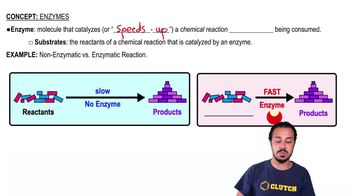
  • What is the main function of an enzyme in a chemical reaction?

    An enzyme catalyzes or speeds up a chemical reaction without being consumed or altered by the reaction.
  • How do enzymatic reactions differ from non-enzymatic reactions in terms of speed?

    Enzymatic reactions occur much faster than non-enzymatic reactions, making them feasible for life.
  • What are substrates in the context of enzymatic reactions?

    Substrates are the reactants in a chemical reaction that is catalyzed by an enzyme.
  • What is the difference between substrates and reactants?

    Substrates imply the involvement of an enzyme, while reactants do not necessarily involve an enzyme.
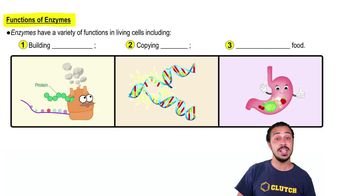
  • Name one function of enzymes in living cells related to proteins.

    Enzymes help build proteins, such as through the action of ribosomes using messenger RNA.
  • How are enzymes involved in genetic continuity?

    Enzymes are involved in copying DNA, ensuring that genetic information is duplicated efficiently.
  • What role do enzymes play in digestion?

    Enzymes speed up the breakdown of food in the stomach, aiding in nutrient digestion.
  • What is enzyme activity?

    Enzyme activity is a measure of the amount of product produced by an enzyme in a certain amount of time.
  • List three environmental factors that affect enzyme activity.

    Temperature, pH, and reactant concentration are three environmental factors that affect enzyme activity.
  • What happens to enzyme activity if the temperature is too high or too low?

    If the temperature is too high or too low, enzyme activity decreases and may not be optimal.
  • How does pH affect enzyme activity?

    Enzyme activity is optimal at a specific pH; too acidic or too basic conditions reduce activity.
  • What effect does reactant concentration have on enzyme activity?

    Low reactant concentration results in low enzyme activity, while too high concentration can oversaturate the enzyme and reduce its effectiveness.
  • What is denaturation in the context of enzymes?

    Denaturation is the loss of enzyme structure due to environmental factors, leading to loss of function.
  • How does denaturation affect enzymatic activity?

    Denatured enzymes lose their shape and function, resulting in decreased enzymatic activity.
  • Why are enzymes essential for life?

    Enzymes make chemical reactions occur fast enough to sustain life by acting as catalysts.