Back

Eukaryotic Post-Translational Regulation definitions

Control buttons has been changed to "navigation" mode.
1/15
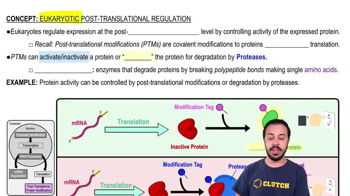
  • Post-Translational Modification

    Covalent chemical change to a protein after translation, altering its activity, stability, or marking it for breakdown.
  • PTM

    Abbreviation for modifications that occur to proteins after translation, impacting their function or fate.
  • Protein Activity

    Functional state of a protein, which can be switched on or off by chemical changes after synthesis.
  • Protease

    Enzyme that breaks down proteins by cleaving polypeptide bonds, producing amino acids.
  • Polypeptide Bond

    Chemical linkage between amino acids in a protein, targeted for cleavage during protein degradation.
  • Protein Degradation

    Process of breaking down proteins into amino acids, often to remove damaged or unneeded proteins.
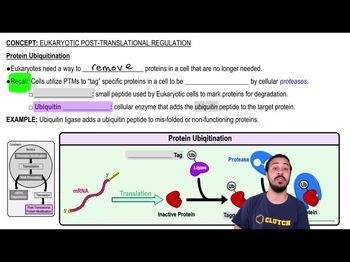
  • Ubiquitination

    Attachment of a small peptide tag to a protein, signaling it for destruction by cellular enzymes.
  • Ubiquitin

    Small peptide that serves as a tag for proteins destined for breakdown by cellular machinery.
  • Ubiquitin Ligase

    Enzyme responsible for attaching a peptide tag to proteins, marking them for degradation.
  • Cytoplasm

    Cellular compartment where protein modifications and tagging for degradation typically occur.
  • Gene Expression

    Overall process by which genetic information leads to functional proteins, regulated at multiple stages.
  • Amino Acid

    Building block of proteins, released when enzymes break down polypeptide chains.
  • Modification Tag

    Chemical group or peptide added to a protein to alter its function or signal its removal.
  • Inactive Protein

    Form of a protein that lacks functional activity, often requiring modification to become active or be degraded.
  • Misfolded Protein

    Protein with incorrect three-dimensional structure, often targeted for removal to maintain cellular health.