Back

Eukaryotic Post-Translational Regulation quiz

Control buttons has been changed to "navigation" mode.
1/15
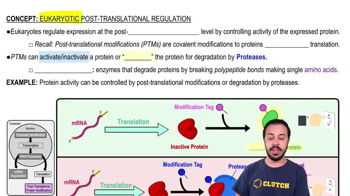
  • What are post-translational modifications (PTMs) in eukaryotic cells?

    PTMs are covalent modifications to proteins that occur after translation. They regulate protein activity by activating, inactivating, or marking proteins for degradation.
  • What does the 'post' in post-translational modification refer to?

    'Post' refers to modifications that occur after translation has taken place.
  • How can PTMs affect protein function?

    PTMs can either activate or inactivate proteins, depending on the specific modification and protein involved.
  • What is the role of proteases in post-translational regulation?

    Proteases are enzymes that degrade proteins by breaking polypeptide bonds, turning proteins into individual amino acids.
  • Where do post-translational modifications typically occur in the cell?

    Post-translational modifications usually occur in the cytoplasm of the cell.
  • How can PTMs serve as a mechanism for turning genes on or off?

    By activating or inactivating proteins, PTMs can effectively turn gene expression on or off after translation.
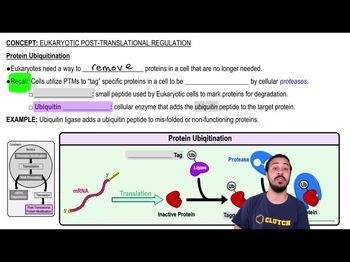
  • What is protein ubiquitination?

    Protein ubiquitination is a type of PTM where a small peptide called ubiquitin is attached to a protein, marking it for degradation.
  • What enzyme is responsible for adding ubiquitin to proteins?

    Ubiquitin ligase is the enzyme that attaches ubiquitin to target proteins.
  • What types of proteins are typically targeted for ubiquitination?

    Misfolded, non-functioning, or no longer needed proteins are commonly targeted for ubiquitination.
  • What happens to a protein after it is tagged with ubiquitin?

    Once tagged with ubiquitin, the protein is recognized and degraded by proteases.
  • How does protein degradation regulate gene expression?

    By degrading proteins that are no longer needed, the cell can turn off the effects of those genes post-translationally.
  • What is the ultimate fate of proteins degraded by proteases?

    Proteins degraded by proteases are broken down into individual amino acids.
  • Why is protein ubiquitination considered a form of post-translational regulation?

    It modifies proteins after translation, controlling their stability and activity by marking them for degradation.
  • What is the significance of PTMs in controlling protein activity?

    PTMs allow the cell to rapidly and reversibly regulate protein function in response to changing needs.
  • How does the addition of a modification tag affect a newly translated protein?

    The modification tag can either activate the protein, making it functional, or mark it for degradation, inactivating its function.