Skip to main content
Microbiology
My Course
Learn
Exam Prep
AI Tutor
Study Guides
Textbook Solutions
Flashcards
Explore
Try the app
My Course
Learn
Exam Prep
AI Tutor
Study Guides
Textbook Solutions
Flashcards
Explore
Try the app
Back
Gel Electrophoresis definitions
You can tap to flip the card.
Gel Electrophoresis
You can tap to flip the card.
👆
Gel Electrophoresis
A laboratory method for separating and visualizing DNA fragments by size using a gel matrix and electrical current.
Track progress
Control buttons has been changed to "navigation" mode.
1/15
Related flashcards
Related practice
Recommended videos
Gel Electrophoresis quiz #1
Gel Electrophoresis
10 Terms
Gel Electrophoresis
17. Biotechnology
3 problems
Topic
Nicole
Southern Blotting
17. Biotechnology
4 problems
Topic
Brendan
17. Biotechnology
10 topics
14 problems
Chapter
Brendan
07:58
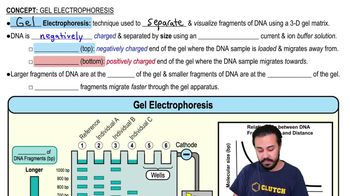
Gel Electrophoresis
6661
views
47
rank
02:34
Gel Electrophoresis Example 1
5124
views
36
rank
Terms in this set (15)
Hide definitions
Gel Electrophoresis
A laboratory method for separating and visualizing DNA fragments by size using a gel matrix and electrical current.
Gel Matrix
A three-dimensional support structure through which DNA fragments migrate, allowing size-based separation.
DNA Fragment
A piece of DNA whose movement through the gel reveals its relative size compared to other pieces.
Cathode
The negatively charged end of the gel where DNA samples are initially loaded for migration.
Anode
The positively charged end of the gel towards which DNA fragments migrate during separation.
Lane
A designated path within the gel where individual DNA samples are loaded and separated.
Well
A small indentation at the top of each lane where DNA samples are placed before electrophoresis.
Reference DNA
A DNA sample of known fragment sizes used to estimate the sizes of unknown fragments in other lanes.
Band
A visible mark in the gel representing DNA fragments of a specific size after separation.
Base Pair
A unit of measurement for DNA fragment size, often abbreviated as bp, indicating the number of nucleotide pairs.
Ion Buffer Solution
A liquid medium that conducts electricity and maintains pH during the electrophoresis process.
Molecular Size
The length of a DNA fragment, typically measured in base pairs, determining its migration speed in the gel.
Electrical Current
A flow of charged particles applied across the gel to drive the movement of DNA fragments.
Comparative Analysis
The process of evaluating DNA fragment patterns across lanes to determine similarities or differences.
Migration Distance
The length a DNA fragment travels through the gel, inversely related to its size.
 BackBack
 07:58
07:58