Back

Genetic Code quiz

Control buttons has been changed to "navigation" mode.
1/15
  • What is the genetic code and what does it link?

    The genetic code is a table that links DNA and RNA sequences to the amino acids in proteins, serving as the connection between nucleic acids and protein sequences.
  • How many nucleotides make up a codon, and where are codons found?

    A codon consists of three nucleotides and is found in the mRNA sequence.
  • What is the first step in using the genetic code to determine a protein sequence?

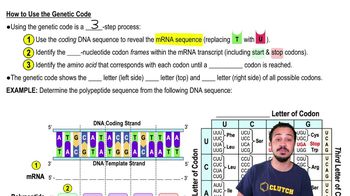
    The first step is to transcribe the DNA coding sequence into an mRNA sequence by replacing all thymines (T) with uracils (U).
  • How is the mRNA sequence related to the DNA coding strand?

    The mRNA sequence is identical to the DNA coding strand except that all thymine (T) bases are replaced with uracil (U).
  • What is the role of the start codon in protein synthesis?

    The start codon (AUG) signals the beginning of protein synthesis and codes for the amino acid methionine.
  • What do stop codons do during translation?

    Stop codons (such as UAA) signal the end of protein synthesis and do not code for any amino acid.
  • How do you identify codons in an mRNA sequence?

    Codons are identified by dividing the mRNA sequence into groups of three nucleotides, starting from the start codon.
  • How is the genetic code table used to determine which amino acid a codon codes for?

    The first letter of the codon determines the row, the second letter determines the column, and the third letter pinpoints the exact amino acid within the box where the row and column intersect.
  • What is the sequence of events in translating a DNA sequence into a protein?

    First, transcribe DNA to mRNA; second, divide mRNA into codons; third, use the genetic code to translate each codon into its corresponding amino acid.
  • What happens when a stop codon is reached during translation?

    Translation stops because stop codons do not code for any amino acid, ending the formation of the polypeptide chain.
  • Is the genetic code the same in all organisms?

    The genetic code is relatively universal across organisms, but there can be some differences between species.
  • What is the direction of polypeptide synthesis during translation?

    Polypeptide synthesis proceeds from the N-terminal to the C-terminal end of the protein.
  • What amino acid does the codon ACC code for?

    The codon ACC codes for the amino acid threonine (THR).
  • What amino acid does the codon CAU code for?

    The codon CAU codes for the amino acid histidine (HIS).
  • What is the function of the DNA template strand during transcription?

    The DNA template strand serves as the template for RNA polymerase to synthesize the complementary mRNA strand.