Skip to main content
Microbiology
My Course
Learn
Exam Prep
AI Tutor
Study Guides
Textbook Solutions
Flashcards
Explore
Try the app
My Course
Learn
Exam Prep
AI Tutor
Study Guides
Textbook Solutions
Flashcards
Explore
Try the app
Back
Gram Stain definitions
You can tap to flip the card.
Gram Stain
You can tap to flip the card.
👆
Gram Stain
A differential staining technique that visually distinguishes bacteria based on cell wall structure using a four-step dye process.
Track progress
Control buttons has been changed to "navigation" mode.
1/15
Related flashcards
Related practice
Recommended videos
Gram Stain quiz #1
Gram Stain
27 Terms
Gram Stain
9. Microscopes
6 problems
Topic
Brendan
Reviewing the Types of Staining
9. Microscopes
5 problems
Topic
9. Microscopes - Part 1 of 3
6 topics
12 problems
Chapter
Nicole
9. Microscopes - Part 2 of 3
8 topics
10 problems
Chapter
Nicole
9. Microscopes - Part 3 of 3
1 topic
3 problems
Chapter
04:57
Gram Stain
4058
views
65
rank
Terms in this set (15)
Hide definitions
Gram Stain
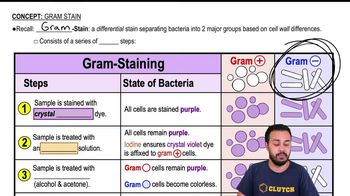
A differential staining technique that visually distinguishes bacteria based on cell wall structure using a four-step dye process.
Differential Stain
A staining method that allows for the identification of distinct groups of microorganisms by color differences.
Gram-Positive Bacteria
Bacterial group retaining purple dye after staining due to a thick cell wall, remaining purple throughout the procedure.
Gram-Negative Bacteria
Bacterial group losing purple dye after decolorization, appearing pink after counterstaining due to a thinner cell wall.
Crystal Violet
The primary dye in the staining process that initially colors all bacterial cells purple.
Iodine Solution
A mordant applied after the primary dye to enhance dye retention in certain bacterial cell walls.
Mordant
A substance that strengthens the binding of a dye to cellular components, ensuring color retention.
Decolorizer
A reagent, typically alcohol or acetone, used to remove the primary dye from some bacterial cells.
Safranin
A counterstain that imparts a pink color to cells that have lost the primary dye, aiding visualization.
Counterstain
A secondary dye applied to cells to provide contrast after the primary dye has been removed from some cells.
Cell Wall
A structural layer in bacteria that determines dye retention and thus the outcome of the staining process.
Unstained Cells
Bacterial cells that appear white or colorless before any dye is applied or after decolorization.
Alcohol
A common decolorizing agent used to differentiate bacterial groups by removing the primary dye from some cells.
Acetone
An alternative decolorizing agent that can be used to strip the primary dye from certain bacterial cells.
Purple Cells
Bacterial cells that retain the primary dye throughout the staining process, indicating a specific cell wall structure.
 BackBack
 04:57
04:57